【嵌入式Linux】嵌入式Linux驱动开发基础知识之总线设备驱动模型
【嵌入式Linux】嵌入式Linux驱动开发基础知识之总线设备驱动模型上一章介绍了分离的驱动设计思想,如果对每种类型的设备都定义一个结构体表示资源定义一个结构体表示驱动函数那就太啰嗦了,于是本章引入了总线设备驱动模型来将这些设备抽象成platform_device/platform_driver增加程序的扩展性
文章目录
前言
韦东山嵌入式Linux驱动开发基础知识学习笔记
文章中大多内容来自韦东山老师的文档,还有部分个人根据自己需求补充的内容
视频教程地址:https://www.bilibili.com/video/BV14f4y1Q7ti
上一章介绍了分离的驱动设计思想,如果对每种类型的设备都定义一个结构体表示资源定义一个结构体表示驱动函数那就太啰嗦了,于是本章引入了总线设备驱动模型来将这些设备抽象成platform_device/platform_driver增加程序的扩展性
1、驱动编写的三种方法
1.1、传统写法
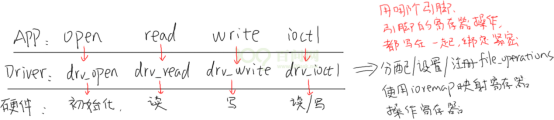
▲传统写法
有关资源和驱动的逻辑写死在代码中,最简单粗暴,但是扩展性不高且每次修改引脚都需要重新编译
1.2、总线驱动模型
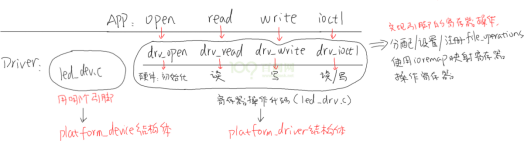
▲总线设备驱动模型
在总线设备驱动模型中引入了platform_device/platform_driver结构体将资源/驱动分离开来,这样做的有点是代码容易扩展,缺点是冗余代码较多,例如在修改设备引脚的代码是需要重新编译
1.3、设备树驱动模型
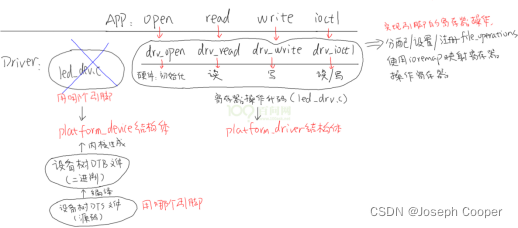
▲设备树驱动模型
关于资源的定义可以通过一个配置文件来定义,我们将其称为设备树DTS文件,设备树DTS文件编译生成二进制的DTB文件通过内核处理可以生成 platform_device结构体,通过这种方式可以提高扩展性的同时减少冗余,在修改引脚时只需要修改dts文件然后编译生成dtb文件就可以。
2、Linux实现分离:Bus/Dev/Drv模型
2.1、Bus/Dev/Drv模型
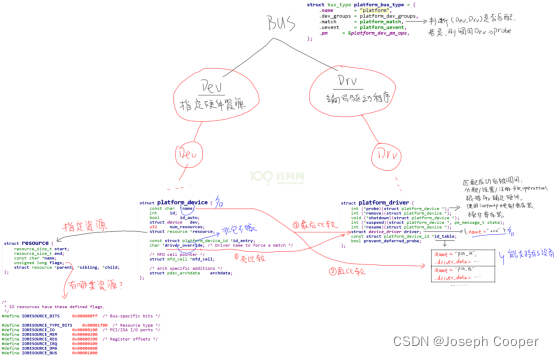
▲
几个重要的数据结构:struct platform_devicestruct platform_driverstruct resourcestruct bus_type
struct platform_device {
	const char	*name;
	int		id;
	bool		id_auto;
	struct device	dev;
	u64		platform_dma_mask;
	u32		num_resources;
	struct resource	*resource;

	const struct platform_device_id	*id_entry;
	char *driver_override; /* Driver name to force a match */

	/* MFD cell pointer */
	struct mfd_cell *mfd_cell;

	/* arch specific additions */
	struct pdev_archdata	archdata;
};

struct platform_driver {
	int (*probe)(struct platform_device *);
	int (*remove)(struct platform_device *);
	void (*shutdown)(struct platform_device *);
	int (*suspend)(struct platform_device *, pm_message_t state);
	int (*resume)(struct platform_device *);
	struct device_driver driver;
	const struct platform_device_id *id_table;
	bool prevent_deferred_probe;
};

struct resource {
	resource_size_t start;
	resource_size_t end;
	const char *name;
	unsigned long flags;
	unsigned long desc;
	struct resource *parent, *sibling, *child;
};
/*
 * IO resources have these defined flags.
 *
 * PCI devices expose these flags to userspace in the "resource" sysfs file,
 * so don't move them.
 */
#define IORESOURCE_BITS		0x000000ff	/* Bus-specific bits */

#define IORESOURCE_TYPE_BITS	0x00001f00	/* Resource type */
#define IORESOURCE_IO		0x00000100	/* PCI/ISA I/O ports */
#define IORESOURCE_MEM		0x00000200
#define IORESOURCE_REG		0x00000300	/* Register offsets */
#define IORESOURCE_IRQ		0x00000400
#define IORESOURCE_DMA		0x00000800
#define IORESOURCE_BUS		0x00001000

#define IORESOURCE_PREFETCH	0x00002000	/* No side effects */
#define IORESOURCE_READONLY	0x00004000
#define IORESOURCE_CACHEABLE	0x00008000
#define IORESOURCE_RANGELENGTH	0x00010000
#define IORESOURCE_SHADOWABLE	0x00020000

#define IORESOURCE_SIZEALIGN	0x00040000	/* size indicates alignment */
#define IORESOURCE_STARTALIGN	0x00080000	/* start field is alignment */

#define IORESOURCE_MEM_64	0x00100000
#define IORESOURCE_WINDOW	0x00200000	/* forwarded by bridge */
#define IORESOURCE_MUXED	0x00400000	/* Resource is software muxed */

#define IORESOURCE_EXT_TYPE_BITS 0x01000000	/* Resource extended types */
#define IORESOURCE_SYSRAM	0x01000000	/* System RAM (modifier) */

#define IORESOURCE_EXCLUSIVE	0x08000000	/* Userland may not map this resource */

#define IORESOURCE_DISABLED	0x10000000
#define IORESOURCE_UNSET	0x20000000	/* No address assigned yet */
#define IORESOURCE_AUTO		0x40000000
#define IORESOURCE_BUSY		0x80000000	/* Driver has marked this resource busy */

struct bus_type {
	const char		*name;
	const char		*dev_name;
	struct device		*dev_root;
	const struct attribute_group **bus_groups;
	const struct attribute_group **dev_groups;
	const struct attribute_group **drv_groups;

	int (*match)(struct device *dev, struct device_driver *drv);
	int (*uevent)(struct device *dev, struct kobj_uevent_env *env);
	int (*probe)(struct device *dev);
	int (*remove)(struct device *dev);
	void (*shutdown)(struct device *dev);

	int (*online)(struct device *dev);
	int (*offline)(struct device *dev);

	int (*suspend)(struct device *dev, pm_message_t state);
	int (*resume)(struct device *dev);

	int (*num_vf)(struct device *dev);

	int (*dma_configure)(struct device *dev);

	const struct dev_pm_ops *pm;

	const struct iommu_ops *iommu_ops;

	struct subsys_private *p;
	struct lock_class_key lock_key;

	bool need_parent_lock;
};
2.2、device和driver的匹配规则
2.2.1、匹配规则
最先比较:platform_device. driver_override和platform_driver.driver.name
这两个变量设计用于强制匹配,所以其优先级最高,当两个变量中内容相同时,给platform_device匹配platform_driver
然后比较:platform_device. name和platform_driver.id_table[i].name
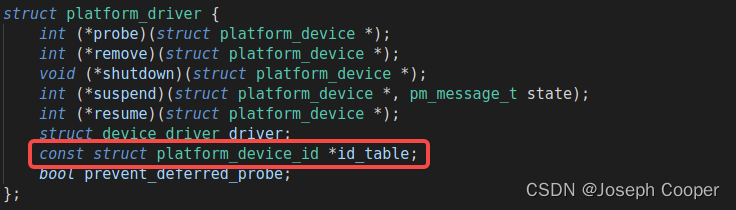
▲platform_driver
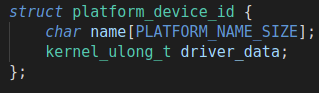
▲platform_device_id
Platform_driver.id_table是“platform_device_id”指针,表示该drv支持若干个device,它里面列出了各个device的{.name, .driver_data},其中的“name”表示该drv支持的设备的名字,driver_data是些提供给该device的私有数据。
最后比较:platform_device.name和platform_driver.driver.name
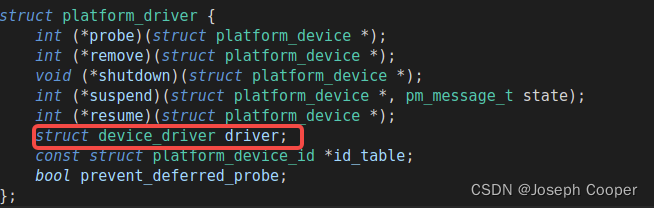
▲platform_driver
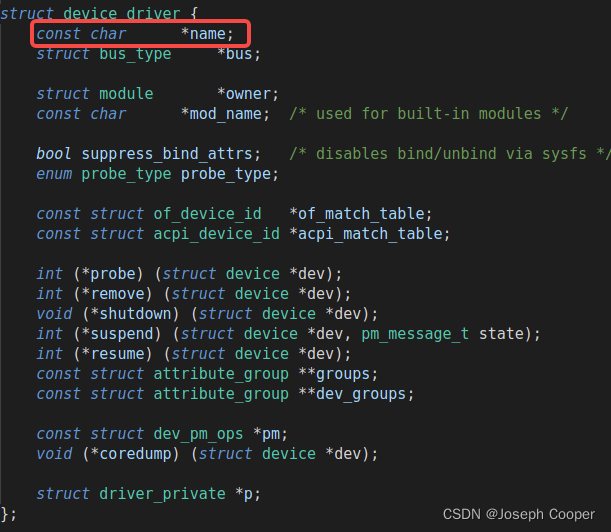
▲device_driver
platform_driver.id_table可能为空,
这时可以根据platform_driver.driver.name来寻找同名的platform_device。
2.2.1、函数调用关系
platform_device的注册匹配
platform_device_register
platform_device_add
    device_add
        bus_add_device // 放入链表
        bus_probe_device  // probe枚举设备,即找到匹配的(dev, drv)
            device_initial_probe
                __device_attach
                    bus_for_each_drv(...,__device_attach_driver,...)
                        __device_attach_driver
                            driver_match_device(drv, dev) // 是否匹配
                            driver_probe_device         // 调用drv的probe
platform_driver的注册匹配
platform_driver_register
__platform_driver_register
    driver_register
        bus_add_driver // 放入链表
            driver_attach(drv)
                    bus_for_each_dev(drv->bus, NULL, drv, __driver_attach);
                        __driver_attach
                            driver_match_device(drv, dev) // 是否匹配
                            driver_probe_device         // 调用drv的probe
2.3、常用函数
注册和反注册函数
platform_device_register/ platform_device_unregister
platform_driver_register/ platform_driver_unregister
platform_add_devices // 注册多个device
/**
 * platform_device_register - add a platform-level device
 * @pdev: platform device we're adding
 */
int platform_device_register(struct platform_device *pdev)
/**
 * platform_device_unregister - unregister a platform-level device
 * @pdev: platform device we're unregistering
 *
 * Unregistration is done in 2 steps. First we release all resources
 * and remove it from the subsystem, then we drop reference count by
 * calling platform_device_put().
 */
void platform_device_unregister(struct platform_device *pdev)
/**
 * __platform_driver_register - register a driver for platform-level devices
 * @drv: platform driver structure
 * @owner: owning module/driver
 */
 #define platform_driver_register(drv) \
	__platform_driver_register(drv, THIS_MODULE)
int __platform_driver_register(struct platform_driver *drv,
				struct module *owner)
/**
 * platform_driver_unregister - unregister a driver for platform-level devices
 * @drv: platform driver structure
 */
void platform_driver_unregister(struct platform_driver *drv)
/**
 * platform_add_devices - add a numbers of platform devices
 * @devs: array of platform devices to add
 * @num: number of platform devices in array
 */
int platform_add_devices(struct platform_device **devs, int num)
获取资源函数
返回该dev中某类型(type)资源中的第num个:
/**
 * platform_get_resource - get a resource for a device
 * @dev: platform device
 * @type: resource type
 * @num: resource index
 */
struct resource *platform_get_resource(struct platform_device *dev,
				       unsigned int type, unsigned int num)
返回该dev所用的第几个(num)中断:
/**
 * platform_get_irq - get an IRQ for a device
 * @dev: platform device
 * @num: IRQ number index
 *
 * Gets an IRQ for a platform device and prints an error message if finding the
 * IRQ fails. Device drivers should check the return value for errors so as to
 * not pass a negative integer value to the request_irq() APIs.
 *
 * Example:
 *		int irq = platform_get_irq(pdev, 0);
 *		if (irq < 0)
 *			return irq;
 *
 * Return: IRQ number on success, negative error number on failure.
 */
int platform_get_irq(struct platform_device *dev, unsigned int num)
通过名字(name)返回该dev的某类型(type)资源:
/**
 * platform_get_resource_byname - get a resource for a device by name
 * @dev: platform device
 * @type: resource type
 * @name: resource name
 */
struct resource *platform_get_resource_byname(struct platform_device *dev,
					      unsigned int type,
					      const char *name)
通过名字(name)返回该dev的中断号:
/**
 * platform_get_irq_byname - get an IRQ for a device by name
 * @dev: platform device
 * @name: IRQ name
 *
 * Get an IRQ like platform_get_irq(), but then by name rather then by index.
 *
 * Return: IRQ number on success, negative error number on failure.
 */
int platform_get_irq_byname(struct platform_device *dev, const char *name)
2.4、怎么写程序
2.4.1、分配/设置/注册platform_device结构体
在里面定义所用资源,指定设备名字。
2.4.2、分配/设置/注册platform_driver结构体
在其中的probe函数里,分配/设置/注册file_operations结构体,
并从platform_device中确实所用硬件资源。
指定platform_driver的名字。
3、LED模板驱动程序的改造:总线设备驱动模型
原先的框架: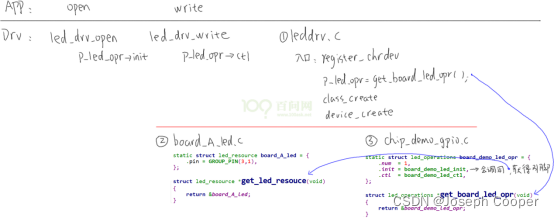
▲原先的框架
要实现的框架: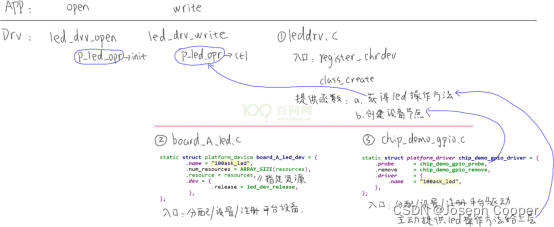
▲要实现的框架
在之前的工程中一直都是使用一个ko来加载驱动,由于引入了总线设备模型,资源,个性化驱动,通用驱动需要分别编译和使用ko来加载,这也实现了编译过程的分离,在修改资源时不用编译整个模块
定义platform_device和resource
board_A_led.c
#include <linux/module.h>

#include <linux/fs.h>
#include <linux/errno.h>
#include <linux/miscdevice.h>
#include <linux/kernel.h>
#include <linux/major.h>
#include <linux/mutex.h>
#include <linux/proc_fs.h>
#include <linux/seq_file.h>
#include <linux/stat.h>
#include <linux/init.h>
#include <linux/device.h>
#include <linux/tty.h>
#include <linux/kmod.h>
#include <linux/gfp.h>
#include <linux/platform_device.h>

#include "led_resource.h"

/* 卸载platform_device时会被调用,如果不提供内核会打印警告信息 */
static void led_dev_release(struct device *dev)
{
}

static struct resource resources[] = {
        {
                /* 引脚资源 */
                .start = GROUP_PIN(3,1),
                /* type */
                .flags = IORESOURCE_IRQ,
                /* name */
                .name = "100ask_led_pin",
        },
        {
                .start = GROUP_PIN(5,8),
                .flags = IORESOURCE_IRQ,
                .name = "100ask_led_pin",
        },
};


static struct platform_device board_A_led_dev = {
        .name = "100ask_led",
        /* ARRAY_SIZE返回数组长度 */
        .num_resources = ARRAY_SIZE(resources),
        .resource = resources,
        .dev = {
                .release = led_dev_release,
         },
};

static int __init led_dev_init(void)
{
    int err;

    err = platform_device_register(&board_A_led_dev);

    return 0;
}

static void __exit led_dev_exit(void)
{
    platform_device_unregister(&board_A_led_dev);
}

module_init(led_dev_init);
module_exit(led_dev_exit);

MODULE_LICENSE("GPL");
定义platform_driver
#include <linux/module.h>

#include <linux/fs.h>
#include <linux/errno.h>
#include <linux/miscdevice.h>
#include <linux/kernel.h>
#include <linux/major.h>
#include <linux/mutex.h>
#include <linux/proc_fs.h>
#include <linux/seq_file.h>
#include <linux/stat.h>
#include <linux/init.h>
#include <linux/device.h>
#include <linux/tty.h>
#include <linux/kmod.h>
#include <linux/gfp.h>
#include <linux/platform_device.h>

#include "led_opr.h"
#include "leddrv.h"
#include "led_resource.h"

/* 每个数组单位表示一个LEDPIN */
static int g_ledpins[100];
/* LED设备数量 */
static int g_ledcnt = 0;

/* 设备init函数 */
static int board_demo_led_init (int which) /* 初始化LED, which-哪个LED */
{
    //printk("%s %s line %d, led %d\n", __FILE__, __FUNCTION__, __LINE__, which);

    printk("init gpio: group %d, pin %d\n", GROUP(g_ledpins[which]), PIN(g_ledpins[which]));
    switch(GROUP(g_ledpins[which]))
    {
        case 0:
        {
            printk("init pin of group 0 ...\n");
            break;
        }
        case 1:
        {
            printk("init pin of group 1 ...\n");
            break;
        }
        case 2:
        {
            printk("init pin of group 2 ...\n");
            break;
        }
        case 3:
        {
            printk("init pin of group 3 ...\n");
            break;
        }
    }

    return 0;
}

/* 设备ctl函数 */
static int board_demo_led_ctl (int which, char status) /* 控制LED, which-哪个LED, status:1-亮,0-灭 */
{
    //printk("%s %s line %d, led %d, %s\n", __FILE__, __FUNCTION__, __LINE__, which, status ? "on" : "off");
    printk("set led %s: group %d, pin %d\n", status ? "on" : "off", GROUP(g_ledpins[which]), PIN(g_ledpins[which]));

    switch(GROUP(g_ledpins[which]))
    {
        case 0:
        {
            printk("set pin of group 0 ...\n");
            break;
        }
        case 1:
        {
            printk("set pin of group 1 ...\n");
            break;
        }
        case 2:
        {
            printk("set pin of group 2 ...\n");
            break;
        }
        case 3:
        {
            printk("set pin of group 3 ...\n");
            break;
        }
    }

    return 0;
}

static struct led_operations board_demo_led_opr = {
    .init = board_demo_led_init,
    .ctl  = board_demo_led_ctl,
};

struct led_operations *get_board_led_opr(void)
{
    return &board_demo_led_opr;
}
/* 从资源resource中获取PIN和设备数量信息,在内核中创建设备 */
static int chip_demo_gpio_probe(struct platform_device *pdev)
{
    struct resource *res;
    int i = 0;

    while (1)
    {
        /* 返回pdev中IORESOURCE_IRQ类型(type)资源中的第i个 */
        res = platform_get_resource(pdev, IORESOURCE_IRQ, i++);
        if (!res)
            break;

        g_ledpins[g_ledcnt] = res->start;
        /* 调用上层函数在ledclass中创建设备 */
        led_class_create_device(g_ledcnt);
        g_ledcnt++;
    }
    return 0;

}

/* 在内核中删除设备 */
static int chip_demo_gpio_remove(struct platform_device *pdev)
{
    struct resource *res;
    int i = 0;

    /* 在内核中删除设备 */
    while (1)
    {
        res = platform_get_resource(pdev, IORESOURCE_IRQ, i);
        if (!res)
            break;

        led_class_destroy_device(i);
        i++;
        g_ledcnt--;
    }
    return 0;
}


static struct platform_driver chip_demo_gpio_driver = {
    /* device和driver匹配完成后会调用probe函数 */
    .probe      = chip_demo_gpio_probe,
    .remove     = chip_demo_gpio_remove,
    .driver     = {
        .name   = "100ask_led",
    },
};

static int __init chip_demo_gpio_drv_init(void)
{
    int err;

    err = platform_driver_register(&chip_demo_gpio_driver);
    /* 向上层注册board_demo_led_opr,进而上层可以访问设备 */
    register_led_operations(&board_demo_led_opr);

    return 0;
}

static void __exit lchip_demo_gpio_drv_exit(void)
{
    platform_driver_unregister(&chip_demo_gpio_driver);
}

module_init(chip_demo_gpio_drv_init);
module_exit(lchip_demo_gpio_drv_exit);

MODULE_LICENSE("GPL");
定义通用驱动
leddrv.c
#include <linux/module.h>

#include <linux/fs.h>
#include <linux/errno.h>
#include <linux/miscdevice.h>
#include <linux/kernel.h>
#include <linux/major.h>
#include <linux/mutex.h>
#include <linux/proc_fs.h>
#include <linux/seq_file.h>
#include <linux/stat.h>
#include <linux/init.h>
#include <linux/device.h>
#include <linux/tty.h>
#include <linux/kmod.h>
#include <linux/gfp.h>

#include "led_opr.h"


/* 1. 确定主设备号                                                                 */
static int major = 0;
static struct class *led_class;
struct led_operations *p_led_opr;


#define MIN(a, b) (a < b ? a : b)

/* 向下提供接口,在led_class下创建次设备号为minor的设备 */
void led_class_create_device(int minor)
{
	device_create(led_class, NULL, MKDEV(major, minor), NULL, "100ask_led%d", minor); /* /dev/100ask_led0,1,... */
}
/* 向下提供接口,在led_class下销毁次设备号为minor的设备 */
void led_class_destroy_device(int minor)
{
	device_destroy(led_class, MKDEV(major, minor));
}
/* 向下提供接口,获取下层注册的设备结构体 */
void register_led_operations(struct led_operations *opr)
{
	p_led_opr = opr;
}
/* 向内核提供标签,此操作可以让其他模块调用此模块的函数 */
EXPORT_SYMBOL(led_class_create_device);
EXPORT_SYMBOL(led_class_destroy_device);
EXPORT_SYMBOL(register_led_operations);


/* 3. 实现对应的open/read/write等函数,填入file_operations结构体                   */
static ssize_t led_drv_read (struct file *file, char __user *buf, size_t size, loff_t *offset)
{
	printk("%s %s line %d\n", __FILE__, __FUNCTION__, __LINE__);
	return 0;
}

/* write(fd, &val, 1); */
static ssize_t led_drv_write (struct file *file, const char __user *buf, size_t size, loff_t *offset)
{
	int err;
	char status;
	struct inode *inode = file_inode(file);
	int minor = iminor(inode);

	printk("%s %s line %d\n", __FILE__, __FUNCTION__, __LINE__);
	err = copy_from_user(&status, buf, 1);

	/* 根据次设备号和status控制LED */
	p_led_opr->ctl(minor, status);

	return 1;
}

static int led_drv_open (struct inode *node, struct file *file)
{
	int minor = iminor(node);

	printk("%s %s line %d\n", __FILE__, __FUNCTION__, __LINE__);
	/* 根据次设备号初始化LED */
	p_led_opr->init(minor);

	return 0;
}

static int led_drv_close (struct inode *node, struct file *file)
{
	printk("%s %s line %d\n", __FILE__, __FUNCTION__, __LINE__);
	return 0;
}

/* 2. 定义自己的file_operations结构体                                              */
static struct file_operations led_drv = {
	.owner	 = THIS_MODULE,
	.open    = led_drv_open,
	.read    = led_drv_read,
	.write   = led_drv_write,
	.release = led_drv_close,
};

/* 4. 把file_operations结构体告诉内核:注册驱动程序                                */
/* 5. 谁来注册驱动程序啊?得有一个入口函数:安装驱动程序时,就会去调用这个入口函数 */
static int __init led_init(void)
{
	int err;

	printk("%s %s line %d\n", __FILE__, __FUNCTION__, __LINE__);
	major = register_chrdev(0, "100ask_led", &led_drv);  /* /dev/led */


	led_class = class_create(THIS_MODULE, "100ask_led_class");
	err = PTR_ERR(led_class);
	if (IS_ERR(led_class)) {
		printk("%s %s line %d\n", __FILE__, __FUNCTION__, __LINE__);
		unregister_chrdev(major, "led");
		return -1;
	}

	return 0;
}

/* 6. 有入口函数就应该有出口函数:卸载驱动程序时,就会去调用这个出口函数           */
static void __exit led_exit(void)
{
	printk("%s %s line %d\n", __FILE__, __FUNCTION__, __LINE__);

	class_destroy(led_class);
	unregister_chrdev(major, "100ask_led");
}


/* 7. 其他完善:提供设备信息,自动创建设备节点                                     */

module_init(led_init);
module_exit(led_exit);

MODULE_LICENSE("GPL");
针对EXPORT_SYMBOL:
一般我们编写C程序时,要调用某个文件中的函数,需要在本文件中包含声明有被调用函数的头文件,然后编译连接后,方能找到调用函数。对于模块依赖的情况,不能简单的使用上面的方法,内核提供了一个机制,就是EXPORT_SYMBOL标签内定义的函数或者符号对全部内核代码公开,不用修改内核代码就可以在您的内核模块中直接调用,即使用EXPORT_SYMBOL可以将一个函数以符号的方式导出给其他模块使用。您还可以手工修改内核源代码来导出另外的函数,用于重新编译并加载新内核后的测试。
参考文章:EXPORT_SYMBOL解析

魔乐社区(Modelers.cn) 是一个中立、公益的人工智能社区,提供人工智能工具、模型、数据的托管、展示与应用协同服务,为人工智能开发及爱好者搭建开放的学习交流平台。社区通过理事会方式运作,由全产业链共同建设、共同运营、共同享有,推动国产AI生态繁荣发展。
更多推荐

 0
0 0
0- 0


 已为社区贡献6条内容

所有评论(0)