文本情感分析
·
一、实训要求
1、掌握文本情感分析的基本概念,专业术语;
2、完成基于情感词典的情感分析。
3、完成基于文本分类的情感分析。
4、完成基于SnowNLP库的情感分析。
二、实训环境
- 装有Anaconda 的本地计算机,在Jupyter Notebook 或 PyCharm上完成相关实验任务。
- 安装jieba、SnowNLP、NLTK库。
三、过程截图
1、完成基于情感词典的情感分析。
import re
import jieba
import codecs
from collections import defaultdict  # 导入collections用于创建空白词典

def seg_word(sentence):
    seg_list = jieba.cut(sentence)
    seg_result = []
    for word in seg_list:
        seg_result.append(word)
        stopwords = set()
        stopword = codecs.open('../data/stopwords.txt', 'r',
                               encoding='utf-8')  # 加载停用词
    for word in stopword:
        stopwords.add(word.strip())
    stopword.close()
    return list(filter(lambda x: x not in stopwords, seg_result))

def sort_word(word_dict):
    sen_file = open('../data/BosonNLP_sentiment_score.txt', 'r+',
                    encoding='utf-8')  # 加载Boson情感词典
    sen_list = sen_file.readlines()
    sen_dict = defaultdict()  # 创建词典
    for s in sen_list:
        s = re.sub('\n', '', s)  # 去除每行最后的换行符
        if s:
            sen_dict[s.split(' ')[0]] = s.split(' ')[1]
    not_file = open('../data/否定词.txt', 'r+',
                    encoding='utf-8')  # 加载否定词词典
    not_list = not_file.readlines()
    for i in range(len(not_list)):
        not_list[i] = re.sub('\n', '', not_list[i])
    degree_file = open('../data/程度副词(中文).txt', 'r+',
                       encoding='utf-8')  # 加载程度副词词典
    degree_list = degree_file.readlines()
    degree_dic = defaultdict()
    for d in degree_list:
        d = re.sub('\n', '', d)
        if d:
            degree_dic[d.split(' ')[0]] = d.split(' ')[1]
    sen_file.close()
    degree_file.close()
    not_file.close()
    sen_word = dict()
    not_word = dict()
    degree_word = dict()
    for word in word_dict.keys():
        if word in sen_dict.keys() and word not in not_list and word not in degree_dic.keys():
            sen_word[word_dict[word]] = sen_dict[word]  # 情感词典中的包含分词结果的词
        elif word in not_list and word not in degree_dic.keys():
            not_word[word_dict[word]] = -1  # 程度副词词典中的包含分词结果的词
        elif word in degree_dic.keys():
            degree_word[word_dict[word]] = degree_dic[word]
    return sen_word, not_word, degree_word  # 返回分类结果

def list_to_dict(word_list):
    data = {}
    for x in range(0, len(word_list)):
        data[word_list[x]] = x
    return data

def socre_sentiment(sen_word, not_word, degree_word, seg_result):
    W = 1  # 初始化权重
    score = 0
    sentiment_index = -1  # 情感词下标初始化
    for i in range(0, len(seg_result)):
        if i in sen_word.keys():
            score += W * float(sen_word[i])
            sentiment_index += 1  # 下一个情感词
            for j in range(len(seg_result)):
                if j in not_word.keys():
                    score *= -1  # 否定词反转情感
                elif j in degree_word.keys():
                    score *= float(degree_word[j])  # 乘以程度副词
    return score

def setiment(sentence):
    seg_list = seg_word(sentence)
    sen_word, not_word, degree_word = sort_word(list_to_dict(seg_list))
    score = socre_sentiment(sen_word, not_word, degree_word, seg_list)
    return seg_list, sen_word, not_word, degree_word, score

if __name__ == '__main__':
    print(setiment('我今天特别开心'))
    print(setiment('我今天很开心、非常兴奋'))
    print(setiment('我昨天开心,今天不开心'))

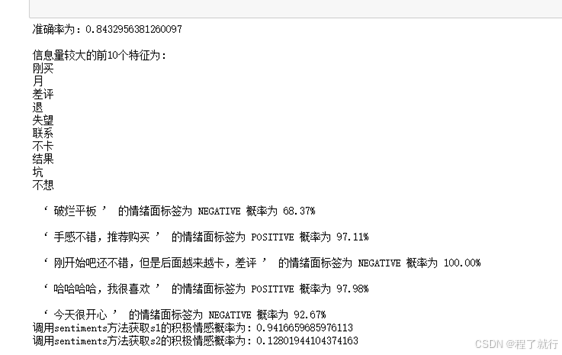
2、完成基于文本分类的情感分析。
import nltk.classify as cf
import nltk.classify.util as cu
import jieba
def setiment(sentences):
    pos_data = []
    with open('../data/pos.txt', 'r+', encoding='utf-8') as pos:  # 读取积极评论
        while True:
            words = pos.readline()
            if words:
                positive = {}  # 创建积极评论的词典
                words = jieba.cut(words)  # 对评论数据结巴分词
                for word in words:
                    positive[word] = True
                pos_data.append((positive, 'POSITIVE'))  # 对积极词赋予POSITIVE标签
            else:
                break
    neg_data = []
    with open('../data/neg.txt', 'r+', encoding='utf-8') as neg:  # 读取消极评论
        while True:
            words = neg.readline()
            if words:
                negative = {}  # 创建消极评论的词典
                words = jieba.cut(words)  # 对评论数据结巴分词
                for word in words:
                    negative[word] = True
                neg_data.append((negative, 'NEGATIVE'))  # 对消极词赋予NEGATIVE标签
            else:
                break
    pos_num, neg_num = int(len(pos_data) * 0.8), int(len(neg_data) * 0.8)
    train_data = pos_data[: pos_num] + neg_data[: neg_num]  # 抽取80%数据
    test_data = pos_data[pos_num: ] + neg_data[neg_num: ]  # 剩余20%数据
    model = cf.NaiveBayesClassifier.train(train_data)
    ac = cu.accuracy(model, test_data)
    print('准确率为:' + str(ac))
    tops = model.most_informative_features()  # 信息量较大的特征
    print('\n信息量较大的前10个特征为:')
    for top in tops[: 10]:
        print(top[0])
    for sentence in sentences:
        feature = {}
        words = jieba.cut(sentence)
        for word in words:
            feature[word] = True
        pcls = model.prob_classify(feature)
        sent = pcls.max()  # 情绪面标签(POSITIVE或NEGATIVE)
        prob = pcls.prob(sent)  # 情绪程度
        print('\n','‘',sentence,'’', '的情绪面标签为', sent, '概率为','%.2f%%' % round(prob * 100, 2))
if __name__ == '__main__':
    # 测试
    sentences = ['破烂平板', '手感不错,推荐购买', '刚开始吧还不错,但是后面越来越卡,差评',
                 '哈哈哈哈,我很喜欢', '今天很开心']
    setiment(sentences)

from snownlp import SnowNLP  # 调用情感分析函数
# 创建snownlp对象,设置要测试的语句
s1 = SnowNLP('这东西真的挺不错的')
s2 = SnowNLP('垃圾东西')
print('调用sentiments方法获取s1的积极情感概率为:',s1.sentiments)
print('调用sentiments方法获取s2的积极情感概率为:',s2.sentiments)
3、完成基于SnowNLP库的情感分析
from snownlp import SnowNLP  # 调用情感分析函数
# 创建snownlp对象,设置要测试的语句
s1 = SnowNLP('这东西真的挺不错的')
s2 = SnowNLP('垃圾东西')
print('调用sentiments方法获取s1的积极情感概率为:',s1.sentiments)
print('调用sentiments方法获取s2的积极情感概率为:',s2.sentiments)


魔乐社区(Modelers.cn) 是一个中立、公益的人工智能社区,提供人工智能工具、模型、数据的托管、展示与应用协同服务,为人工智能开发及爱好者搭建开放的学习交流平台。社区通过理事会方式运作,由全产业链共同建设、共同运营、共同享有,推动国产AI生态繁荣发展。
更多推荐


 9
9 0
0- 0


 已为社区贡献2条内容

所有评论(0)