opencv4+dnn+yolov8识别中国象棋
【代码】opencv4+dnn+yolov8识别中国象棋。
·
opencv4+dnn+yolov8识别中国象棋
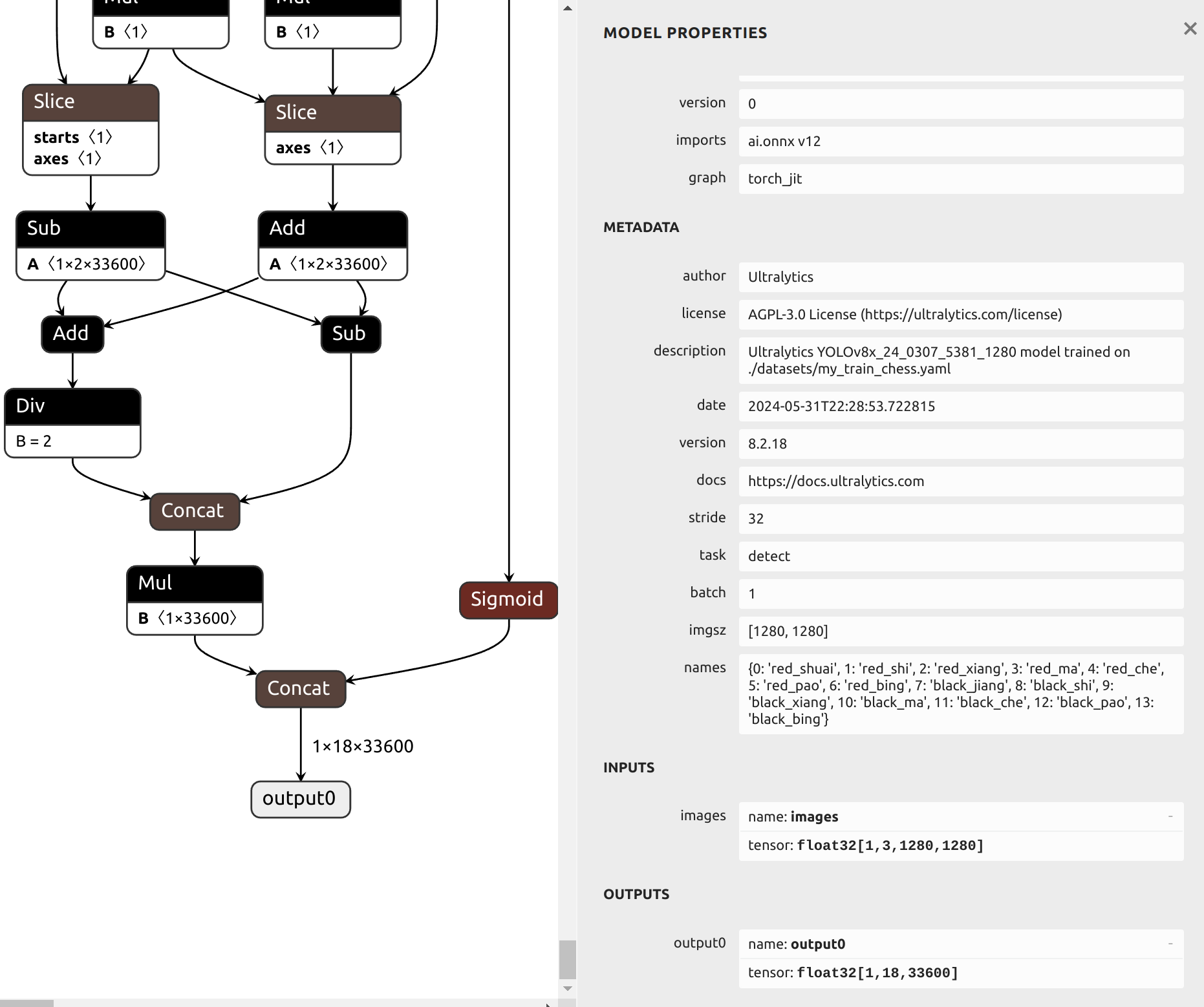
yolov8 pt模型转onnx模型
yolo export model=./weights/yolov8x_24_0307_5381_1280.pt format=onnx dynamic=False opset=12

代码
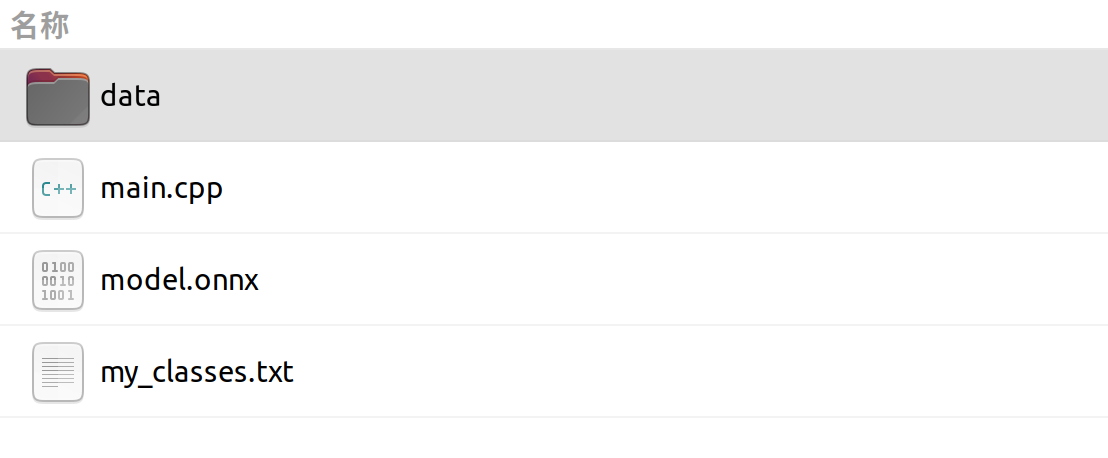
main.cpp
#include "opencv2/opencv.hpp"

#include <fstream>
#include <sstream>

#include <random>

using namespace cv;
using namespace dnn;

float inpWidth;
float inpHeight;
float confThreshold, scoreThreshold, nmsThreshold;
std::vector<std::string> classes;
std::vector<cv::Scalar> colors;

bool letterBoxForSquare = true;

cv::Mat formatToSquare(const cv::Mat &source);

void postprocess(Mat &frame, cv::Size inputSz, const std::vector<Mat> &out, Net &net);

void drawPred(int classId, float conf, int left, int top, int right, int bottom, Mat &frame);

std::random_device rd;
std::mt19937 gen(rd());
std::uniform_int_distribution<int> dis(100, 255);

int main()
{
    printf("[%s][%d] 运行到行号\n", __FUNCTION__, __LINE__);;
    String modelPath = "model.onnx";
    String classesFile = "my_classes.txt";
    // Open a video file or an image file or a camera stream.
    VideoCapture cap;
    cap.open(R"(data/IMG_1779.jpg)");
    printf("[%s][%d] 运行到行号\n", __FUNCTION__, __LINE__);
    // 根据选择的检测模型文件进行配置
    confThreshold = 0.25;
    scoreThreshold = 0.45;
    nmsThreshold = 0.5;
    float scale = 1 / 255.0; // 0.00392
    Scalar mean = {0, 0, 0};
    bool swapRB = true;
    inpWidth = 1280;
    inpHeight = 1280;

    String configPath;

    String framework = "";
    printf("[%s][%d] 运行到行号\n", __FUNCTION__, __LINE__);
    // int backendId = cv::dnn::DNN_BACKEND_OPENCV;
    // int targetId = cv::dnn::DNN_TARGET_CPU;    //cpu  350ms,   opencl 310
    int backendId = cv::dnn::DNN_BACKEND_CUDA;
    int targetId = cv::dnn::DNN_TARGET_CUDA; // cuda  15ms
    printf("[%s][%d] 运行到行号\n", __FUNCTION__, __LINE__);
    // Open file with classes names.
    if (!classesFile.empty())
    {
        printf("[%s][%d] 运行到行号\n", __FUNCTION__, __LINE__);
        const std::string &file = classesFile;
        std::ifstream ifs(file.c_str());
        if (!ifs.is_open())
            CV_Error(Error::StsError, "File " + file + " not found");
        std::string line;
        while (std::getline(ifs, line))
        {
            classes.push_back(line);
            colors.push_back(cv::Scalar(dis(gen), dis(gen), dis(gen)));
        }
    }
    printf("[%s][%d] 运行到行号\n", __FUNCTION__, __LINE__);
    // Load a model.
    Net net = readNet(modelPath, configPath, framework);
    printf("[%s][%d] 运行到行号\n", __FUNCTION__, __LINE__);
    net.setPreferableBackend(backendId);
    printf("[%s][%d] 运行到行号\n", __FUNCTION__, __LINE__);
    net.setPreferableTarget(targetId);
    printf("[%s][%d] 运行到行号\n", __FUNCTION__, __LINE__);
    std::vector<String> outNames = net.getUnconnectedOutLayersNames();
    // std::vector<String> outNames{"output"};
    if (backendId == cv::dnn::DNN_BACKEND_CUDA)
    {
        int dims[] = {1, 3, inpHeight, inpWidth};
        cv::Mat tmp = cv::Mat::zeros(4, dims, CV_32F);
        std::vector<cv::Mat> outs;

        net.setInput(tmp);
        for (int i = 0; i < 10; i++)
            net.forward(outs, outNames); // warmup
    }
    printf("[%s][%d] 运行到行号\n", __FUNCTION__, __LINE__);
    // Create a window
    static const std::string kWinName = "Deep learning object detection in OpenCV";

    cv::namedWindow(kWinName, 0);

    cv::TickMeter tk;
    // Process frames.
    Mat frame, blob;

    while (waitKey(1) < 0)
    {
        printf("[%s][%d] 运行到行号\n", __FUNCTION__, __LINE__);

        // tk.reset();
        // tk.start();

        cap >> frame;
        if (frame.empty())
        {
            waitKey();
            break;
        }
        printf("[%s][%d] 运行到行号\n", __FUNCTION__, __LINE__);
        // Create a 4D blob from a frame.
        cv::Mat modelInput = frame;
        if (letterBoxForSquare && inpWidth == inpHeight)
            modelInput = formatToSquare(modelInput);

        blobFromImage(modelInput, blob, scale, cv::Size2f(inpWidth, inpHeight), mean, swapRB, false);

        // Run a model.
        net.setInput(blob);

        std::vector<Mat> outs;
        // tk.reset();
        // tk.start();

        auto tt1 = cv::getTickCount();
        net.forward(outs, outNames);
        auto tt2 = cv::getTickCount();
        printf("[%s][%d] 运行到行号\n", __FUNCTION__, __LINE__);
        tk.stop();
        postprocess(frame, modelInput.size(), outs, net);
        // tk.stop();

        // Put efficiency information.
        //  std::vector<double> layersTimes;
        //  double freq = getTickFrequency() / 1000;
        //  double t = net.getPerfProfile(layersTimes) / freq;
        //  std::string label = format("Inference time: %.2f ms  (%.2f ms)", t, /*tk.getTimeMilli()*/ (tt2 - tt1) /
        //  cv::getTickFrequency() * 1000);
        std::string label = format("Inference time: %.2f ms", (tt2 - tt1) / cv::getTickFrequency() * 1000);

        cv::putText(frame, label, Point(0, 15), FONT_HERSHEY_SIMPLEX, 0.5, Scalar(0, 255, 0));

        // printf("\r%s\t", label.c_str());
        printf("[%s][%d] 运行到行号\n", __FUNCTION__, __LINE__);
        cv::imshow(kWinName, frame);
        namedWindow(kWinName, 0); // 参数为零,则可以自由拖动
        imshow(kWinName, frame);
        waitKey(10);
        imwrite("1.jpg", frame);
    }
    printf("[%s][%d] 运行到行号\n", __FUNCTION__, __LINE__);
    return 0;
}

cv::Mat formatToSquare(const cv::Mat &source)
{
    int col = source.cols;
    int row = source.rows;
    int _max = MAX(col, row);
    cv::Mat result = cv::Mat::zeros(_max, _max, CV_8UC3);
    source.copyTo(result(cv::Rect(0, 0, col, row)));
    return result;
}

void postprocess(Mat &frame, cv::Size inputSz, const std::vector<Mat> &outs, Net &net)
{
    // yolov8 has an output of shape (batchSize, 84, 8400) (Num classes + box[x,y,w,h] + confidence[c])

    auto tt1 = cv::getTickCount();

    float x_factor = inputSz.width / inpWidth;
    float y_factor = inputSz.height / inpHeight;

    std::vector<int> class_ids;
    std::vector<float> confidences;
    std::vector<cv::Rect> boxes;

    // int rows = outs[0].size[1];
    // int dimensions = outs[0].size[2];

    // [1, 84, 8400] -> [8400,84]
    int rows = outs[0].size[2];
    int dimensions = outs[0].size[1];

    auto tmp = outs[0].reshape(1, dimensions);
    cv::transpose(tmp, tmp);

    float *data = (float *)tmp.data;

    for (int i = 0; i < rows; ++i)
    {
        // float confidence = data[4];
        // if(confidence >= confThreshold) {
        float *classes_scores = data + 4;

        cv::Mat scores(1, classes.size(), CV_32FC1, classes_scores);
        cv::Point class_id;
        double max_class_score;

        minMaxLoc(scores, 0, &max_class_score, 0, &class_id);

        if (max_class_score > scoreThreshold)
        {
            confidences.push_back(max_class_score);
            class_ids.push_back(class_id.x);

            float x = data[0];
            float y = data[1];
            float w = data[2];
            float h = data[3];

            int left = int((x - 0.5 * w) * x_factor);
            int top = int((y - 0.5 * h) * y_factor);
            int width = int(w * x_factor);
            int height = int(h * y_factor);

            boxes.push_back(cv::Rect(left, top, width, height));
        }
        //}

        data += dimensions;
    }

    std::vector<int> indices;
    NMSBoxes(boxes, confidences, scoreThreshold, nmsThreshold, indices);

    auto tt2 = cv::getTickCount();
    std::string label = format("NMS time: %.2f ms", (tt2 - tt1) / cv::getTickFrequency() * 1000);
    cv::putText(frame, label, Point(0, 30), FONT_HERSHEY_SIMPLEX, 0.5, Scalar(0, 255, 0));

    for (size_t i = 0; i < indices.size(); ++i)
    {
        int idx = indices[i];
        Rect box = boxes[idx];
        drawPred(class_ids[idx], confidences[idx], box.x, box.y, box.x + box.width, box.y + box.height, frame);
    }
}

void drawPred(int classId, float conf, int left, int top, int right, int bottom, Mat &frame)
{
    rectangle(frame, Point(left, top), Point(right, bottom), Scalar(0, 255, 0));

    std::string label = format("%.2f", conf);
    Scalar color = Scalar::all(255);
    if (!classes.empty())
    {
        CV_Assert(classId < (int)classes.size());
        label = classes[classId] + ": " + label;
        color = colors[classId];
    }

    int baseLine;
    Size labelSize = getTextSize(label, FONT_HERSHEY_SIMPLEX, 0.5, 1, &baseLine);

    top = max(top, labelSize.height);
    rectangle(frame, Point(left, top - labelSize.height), Point(left + labelSize.width, top + baseLine), color, FILLED);
    cv::putText(frame, label, Point(left, top), FONT_HERSHEY_SIMPLEX, 0.5, Scalar());
}
my_classes.txt
red_shuai
red_shi
red_xiang
red_ma
red_che
red_pao
red_bing
black_jiang
black_shi
black_xiang
black_ma
black_che
black_pao
black_bing
编译
g++ -o main main.cpp `pkg-config opencv4 --cflags --libs`
运行
./main

魔乐社区(Modelers.cn) 是一个中立、公益的人工智能社区,提供人工智能工具、模型、数据的托管、展示与应用协同服务,为人工智能开发及爱好者搭建开放的学习交流平台。社区通过理事会方式运作,由全产业链共同建设、共同运营、共同享有,推动国产AI生态繁荣发展。
更多推荐

 1
1 0
0- 0


 已为社区贡献12条内容

所有评论(0)