Python - 数据分析三剑客之NumPy-SciPy
是一个基于的开源Python库,专为科学计算设计,提供了大量高效算法和工具集,涵盖数学、物理、工程等领域的关键问题。
阅读前可参考NumPy文章
https://blog.csdn.net/MinggeQingchun/article/details/148253682 https://blog.csdn.net/MinggeQingchun/article/details/148253682SciPy 是一个基于NumPy的开源Python库,专为科学计算设计,提供了大量高效算法和工具集,涵盖数学、物理、工程等领域的关键问题。
一、SciPy 基础结构
1、SciPy核心功能
1、线性代数:通过scipy.linalg提供矩阵运算(如LU分解,特征值计算)、线性方程组求解
2、优化算法:scipy.optimize支持无约束(如BFGS)和有约束优化(如线性约束),适用于最小化目标函数或解决复杂优化问题
3、数值积分与微分方程:scipy.integrate模块可进行定积分计算和常/偏微分方程求解(如阻尼器震荡的数值模拟)
4、信号处理:scipy.signal提供滤波器设计(如低通滤波器)、傅里叶变换工具,适用于音频或图像处理场景
5、统计与特殊函数:scipy.stats和scipy.special包含概率分布计算、贝叶斯统计以及特殊数学函数(如伽玛函数)等
2、SciPy底层实现原理以及高效性能
SciPy 的核心算法采用 C/Fortran/C++ 编写,结合 Python 的灵活性和 NumPy 的数组操作能力,实现高性能计算。如:
【1】稀疏矩阵支持(如 scipy.sparse),适用于大规模数据处理
【2】多线程优化(例如积分模块的并行计算),提升大规模运算效率。
SciPy 由多个子模块组成,每个子模块专注于特定领域的科学计算:
import scipy
from scipy import optimize, integrate, interpolate, linalg, stats, fft, signal, ndimage, sparse
二、主要功能模块
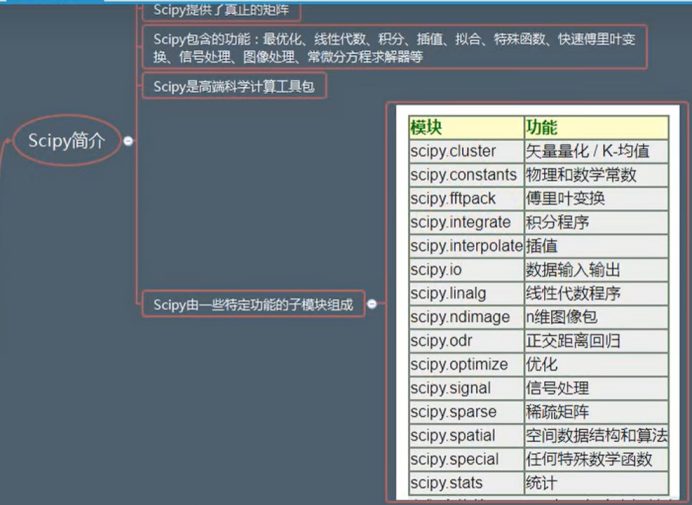
2.1 优化与求根 (scipy.optimize)
1、最小化函数:
from scipy.optimize import minimize

def rosen(x):
    return sum(100.0*(x[1:]-x[:-1]**2.0)**2.0 + (1-x[:-1])**2.0)

x0 = [1.3, 0.7, 0.8, 1.9, 1.2]
res = minimize(rosen, x0, method='nelder-mead', options={'xatol': 1e-8, 'disp': True})
print(res.x)2、方程求根:
from scipy.optimize import root

def func(x):
    return x + 2*np.cos(x)

sol = root(func, 0.3)
print(sol.x)
2.2 积分 (scipy.integrate)
定积分计算:
from scipy.integrate import quad

result, error = quad(lambda x: np.exp(-x**2), -np.inf, np.inf)
print(f"积分结果: {result}, 误差估计: {error}")常微分方程求解:
from scipy.integrate import solve_ivp

def lotkavolterra(t, z, a, b, c, d):
    x, y = z
    return [a*x - b*x*y, -c*y + d*x*y]

sol = solve_ivp(lotkavolterra, [0, 15], [10, 5], args=(1.5, 1, 3, 1), dense_output=True)
2.3 插值 (scipy.interpolate)
一维插值:
from scipy.interpolate import interp1d

x = np.linspace(0, 10, num=11)
y = np.cos(-x**2/9.0)
f = interp1d(x, y, kind='cubic')

xnew = np.linspace(0, 10, num=41)
plt.plot(x, y, 'o', xnew, f(xnew), '-')
plt.legend(['数据点', '三次样条'], loc='best')
plt.show()
2.4 线性代数 (scipy.linalg)
矩阵运算:
from scipy import linalg

A = np.array([[1, 2], [3, 4]])
# 计算行列式
print(linalg.det(A))
# 计算逆矩阵
print(linalg.inv(A))
# 特征值和特征向量
eigenvalues, eigenvectors = linalg.eig(A)
2.5 统计函数 (scipy.stats)
1、概率分布:
from scipy import stats

# 正态分布
norm_dist = stats.norm(loc=0, scale=1)
print(f"PDF at 0: {norm_dist.pdf(0)}")
print(f"CDF at 1: {norm_dist.cdf(1)}")

# 生成随机变量
samples = norm_dist.rvs(size=1000)
plt.hist(samples, bins=30, density=True)
x = np.linspace(-4, 4, 100)
plt.plot(x, norm_dist.pdf(x))
plt.show()2、假设检验:
# t检验
a = np.random.normal(0, 1, size=100)
b = np.random.normal(1, 1, size=100)
t_stat, p_val = stats.ttest_ind(a, b)
print(f"t统计量: {t_stat}, p值: {p_val}")
2.6 傅里叶变换 (scipy.fft)
from scipy.fft import fft, fftfreq

# 采样频率
N = 600
T = 1.0 / 800.0
x = np.linspace(0.0, N*T, N, endpoint=False)
y = np.sin(50.0 * 2.0*np.pi*x) + 0.5*np.sin(80.0 * 2.0*np.pi*x)

yf = fft(y)
xf = fftfreq(N, T)[:N//2]

plt.plot(xf, 2.0/N * np.abs(yf[0:N//2]))
plt.grid()
plt.show()
可参考
深入浅出的讲解傅里叶变换(真正的通俗易懂) - h2z - 博客园
2.7 信号处理 (scipy.signal)
from scipy import signal

# 设计一个低通滤波器
b, a = signal.butter(4, 100, 'low', analog=True)
w, h = signal.freqs(b, a)
plt.semilogx(w, 20*np.log10(abs(h)))
plt.title('Butterworth滤波器频率响应')
plt.xlabel('频率 [rad/s]')
plt.ylabel('振幅 [dB]')
plt.grid(which='both', axis='both')
plt.show()
2.8 图像处理 (scipy.ndimage)
from scipy import ndimage
from scipy import misc

# 图像处理示例
face = misc.face(gray=True)
blurred_face = ndimage.gaussian_filter(face, sigma=3)

fig, (ax1, ax2) = plt.subplots(1, 2, figsize=(10, 5))
ax1.imshow(face, cmap='gray')
ax1.set_title('原始图像')
ax2.imshow(blurred_face, cmap='gray')
ax2.set_title('高斯模糊')
plt.show()
2.9 稀疏矩阵 (scipy.sparse)
from scipy import sparse

# 创建稀疏矩阵
row = np.array([0, 1, 2, 0])
col = np.array([0, 1, 2, 2])
data = np.array([1, 1, 1, 1])
sparse_matrix = sparse.coo_matrix((data, (row, col)), shape=(3, 3))

print("稀疏矩阵:")
print(sparse_matrix.toarray())
3 实际应用
3.1、曲线拟合
from scipy.optimize import curve_fit

def func(x, a, b, c):
    return a * np.exp(-b * x) + c

xdata = np.linspace(0, 4, 50)
y = func(xdata, 2.5, 1.3, 0.5)
ydata = y + 0.2 * np.random.normal(size=len(xdata))

popt, pcov = curve_fit(func, xdata, ydata)
plt.plot(xdata, ydata, 'b-', label='数据')
plt.plot(xdata, func(xdata, *popt), 'r-', label='拟合')
plt.legend()
plt.show()
3.2、数值积分应用
from scipy.integrate import dblquad

# 计算二重积分
def integrand(y, x):
    return np.exp(-x**2 - y**2)

x_lower = 0
x_upper = 10
y_lower = 0
y_upper = 10

result, error = dblquad(integrand, x_lower, x_upper,
                        lambda x: y_lower, lambda x: y_upper)
print(f"积分结果: {result}, 误差估计: {error}")
性能优化技巧
-
向量化运算:尽量使用 NumPy/SciPy 的向量化操作代替循环
-
使用稀疏矩阵:对于大型稀疏矩阵问题
-
选择合适算法:根据问题特点选择最优的数值方法
-
JIT 编译:结合 Numba 加速关键代码

魔乐社区(Modelers.cn) 是一个中立、公益的人工智能社区,提供人工智能工具、模型、数据的托管、展示与应用协同服务,为人工智能开发及爱好者搭建开放的学习交流平台。社区通过理事会方式运作,由全产业链共同建设、共同运营、共同享有,推动国产AI生态繁荣发展。
更多推荐

 11
11 0
0- 0


 已为社区贡献12条内容

所有评论(0)