matlab 增益k,怎样求控制器的增益系数k?
步骤:1. \dot x =A*x + B*u is a state space model, with A and B are known. Now we want to locate the poles p at the desired location, so need the help with designing a controller: u= - k*x。How to choose.
步骤:
1. \dot x =A*x + B*u is a state space model, with A and B are known. Now we want to locate the poles p at the desired location, so need the help with designing a controller: u= - k*x。How to choose the gain k?
Answer: Substituting u= - k*x, then \dot = (A-B*K)x, use place function in Matlab to input (A,B,p), obtaining k from the output.
About the introduction of place function, I attach a paragraph from Wikipedia here:
Description
Given the single- or multi-input system
˙x=Ax+Bu
and a vector p of desired self-conjugate closed-loop pole locations, place computes a gain matrix K such that the state feedback u = –Kx places the closed-loop poles at the locations p. In other words, the eigenvalues of A – BK match the entries of p (up to the ordering).
K = place(A,B,p) places the desired closed-loop poles p by computing a state-feedback gain matrix K. All the inputs of the plant are assumed to be control inputs. The length of p must match the row size of A. place works for multi-input systems and is based on the algorithm from [1]. This algorithm uses the extra degrees of freedom to find a solution that minimizes the sensitivity of the closed-loop poles to perturbations in A or B.
[K,prec,message] = place(A,B,p) returns prec, an estimate of how closely the eigenvalues of A – BK match the specified locations p (prec measures the number of accurate decimal digits in the actual closed-loop poles). If some nonzero closed-loop pole is more than 10% off from the desired location, message contains a warning message.
You can also use place for estimator gain selection by transposing the A matrix and substituting C' for B.
l = place(A',C',p).'
Examples
Pole Placement Design
Consider a state-space system (a,b,c,d) with two inputs, three outputs, and three states. You can compute the feedback gain matrix needed to place the closed-loop poles at p = [-1 -1.23 -5.0] by
p = [-1 -1.23 -5.0];
K = place(a,b,p)
2. How to design the desired poles?
Answer: Choose a suitable value of \omega (bandwith) and \zeta (damping) of the controlling system:
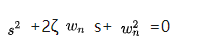
Then use the roots function to input the \omega and \zeta, obtaining the roots (the poles) as the output.
About the introduction of roots function, I attach a paragraph from Wikipedia here:
The roots function calculates the roots of a single-variable polynomial represented by a vector of coefficients.
For example, create a vector to represent the polynomial x2−x−6, then calculate the roots.
p = [1 -1 -6];
r = roots(p)
r =
3
-2
Then with poles and system matrix (A, B), we can calculate the gain k.

魔乐社区(Modelers.cn) 是一个中立、公益的人工智能社区,提供人工智能工具、模型、数据的托管、展示与应用协同服务,为人工智能开发及爱好者搭建开放的学习交流平台。社区通过理事会方式运作,由全产业链共同建设、共同运营、共同享有,推动国产AI生态繁荣发展。
更多推荐


 0
0 0
0- 0


 已为社区贡献4条内容

所有评论(0)