零基础入门深度学习(1) - 感知器 代码实现
·
零基础入门深度学习(1) - 感知器
原参考代码没有使用numpy,且代码是基于(Python2.7),先已修改,使用了numpy且Python3.7
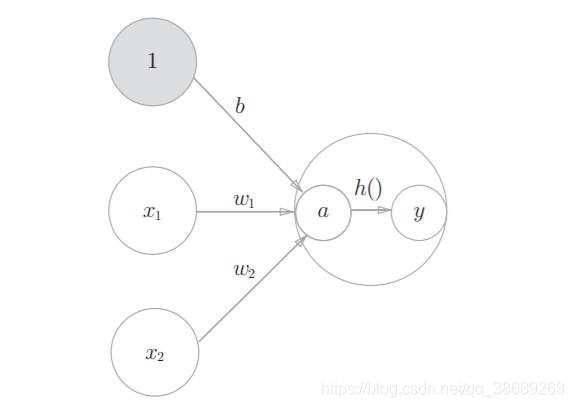
与门
训练出感知器的权重: w1, w2, b
【参考代码一】
#By Bo Yang 2020.12.10
import numpy as np
import time

def get_training_dataset():#training data
    input_vecs = np.array([[1, 1], [0, 0], [1, 0], [0, 1]])
    labels = np.array([1, 0, 0, 0])
    return input_vecs, labels

def step_function(x):#激活函数
    y= x>0
    return y.astype(np.int)

def predict(input_vec,weights1,bias1):#输入向量,输出感知器的计算结果
    a = np.dot(input_vec, weights1.T) + bias1
    y = step_function(a)
    return y

def train(input_vecs,labels,iteration,rate):#训练函数
    for i in range(iteration):
        _one_iteration(input_vecs, labels, rate)

def _one_iteration(input_vecs, labels, rate):#一次迭代,把所有的训练数据过一遍
    global weights
    global bias
    samples = zip(input_vecs, labels) #每个训练样本是(input_vec, label)
    for (input_vec, label) in samples:# 对每个样本,按照感知器规则更新权重
        output = predict(input_vec,weights,bias)
        _update_weights(input_vec, output, label, rate)# 更新权重

def _update_weights(input_vec, output, label, rate):#参数的更新
    global weights
    global bias
    delta = np.array([label]) - output
    weights = weights + (rate * delta)*np.array(input_vec)
    bias = bias + rate * delta # 更新bias

if __name__ == "__main__":
    t1=time.time()
    input_vecs, labels = get_training_dataset()
    global weights,bias
    weights, bias= np.array([0.0 , 0.0]), np.array([0.0])#参数初始化
    rate, iteration= np.array([0.1]), 10#迭代次数

    train(input_vecs,labels,iteration,rate)
    print("weights=",weights,"bias=",bias)
    t2=time.time()
    samples = zip(input_vecs, labels)
    for (input_vec, label) in samples:
        print(input_vec[0],"and",input_vec[1],"=",step_function(predict(input_vec,weights,bias)))
    print("共运行了:",(t2-t1)*1000,"ms")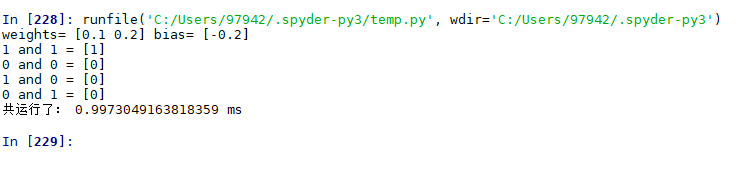
【参考代码二】
#By Bo Yang 2020.12.11
import numpy as np
from functools import reduce

class Perceptron(object):
    def __init__(self, input_num, activator):#初始化感知器,设置输入参数的个数,以及激活函数。
        self.activator = activator
        self.weights = [0.0] * input_num   # 权重向量初始化为0
        self.bias = 0.0   # 偏置项初始化为0

    def __str__(self):#打印学习到的权重、偏置项

        return 'weights\t:%s\nbias\t:%f\n' % (self.weights, self.bias)#这里真的是满满的细节

    def predict(self, input_vec):#输入向量,输出感知器的计算结果
        return self.activator(np.dot(input_vec, self.weights) + self.bias)

    def train(self, input_vecs, labels, iteration, rate):
        #输入训练数据:一组向量、与每个向量对应的label;以及训练轮数、学习率
        for i in range(iteration):
            #print("-----------------------------------------------------------------------")
            self._one_iteration(input_vecs, labels, rate)


    def _one_iteration(self, input_vecs, labels, rate):
        samples = zip(input_vecs, labels) #每个训练样本是(input_vec, label)
        for (input_vec, label) in samples:# 对每个样本,按照感知器规则更新权重
            output = self.predict(input_vec)
            self._update_weights(input_vec, output, label, rate)# 更新权重

    def _update_weights(self, input_vec, output, label, rate):
        delta = label - output
        self.weights = self.weights+input_vec*np.array((rate * delta))
        self.bias += rate * delta # 更新bias
        #print("weights:",self.weights,"bias:",self.bias)


def f(x):
    return 1 if x > 0 else 0


def get_training_dataset():
    input_vecs = [[1, 1], [0, 0], [1, 0], [0, 1]]
    labels = [1, 0, 0, 0]
    return input_vecs, labels


def train_and_perceptron():
    p = Perceptron(2, f)
    input_vecs, labels = get_training_dataset()
    p.train(input_vecs, labels, 10, 0.1)
    return p


if __name__ == '__main__':
    and_perception = train_and_perceptron()

    print(and_perception)
    """
    当使用print输出对象的时候,只要自己定义了__str__(self)方法,那么就会打印从在这个方法中return的数据
    __str__方法需要返回一个字符串,当做这个对象的描写
    """
    print('1 and 1 = %d' % and_perception.predict([1, 1]))
    print('0 and 0 = %d' % and_perception.predict([0, 0]))
    print('1 and 0 = %d' % and_perception.predict([1, 0]))
    print('0 and 1 = %d' % and_perception.predict([0, 1]))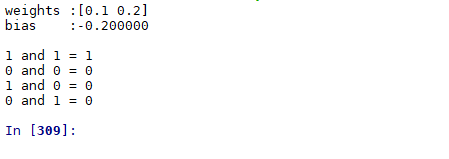
【原代码】
from functools import reduce


class VectorOp(object):#向量计算操作
    """
    实现向量计算操作
    #staticmethod用于修饰类中的方法,
    使其可以在不创建类实例的情况下调用方法
    """

    @staticmethod
    def dot(x, y):
        """
        计算两个向量x和y的内积
        """
        # 首先把x[x1,x2,x3...]和y[y1,y2,y3,...]按元素相乘
        # 变成[x1*y1, x2*y2, x3*y3]
        # 然后利用reduce求和
        return reduce(lambda a, b: a + b, VectorOp.element_multiply(x, y), 0.0)#a的初值为0.0

    @staticmethod
    def element_multiply(x, y):
        """
        将两个向量x和y按元素相乘
        """
        # 首先把x[x1,x2,x3...]和y[y1,y2,y3,...]打包在一起
        # 变成[(x1,y1),(x2,y2),(x3,y3),...]
        # 然后利用map函数计算[x1*y1, x2*y2, x3*y3]
        return list(map(lambda x_y: x_y[0] * x_y[1], zip(x, y)))

    @staticmethod
    def element_add(x, y):
        """
        将两个向量x和y按元素相加
        """
        # 首先把x[x1,x2,x3...]和y[y1,y2,y3,...]打包在一起
        # 变成[(x1,y1),(x2,y2),(x3,y3),...]
        # 然后利用map函数计算[x1+y1, x2+y2, x3+y3]
        return list(map(lambda x_y: x_y[0] + x_y[1], zip(x, y)))

    @staticmethod
    def scala_multiply(v, s):
        """
        将向量v中的每个元素和标量s相乘
        """
        return map(lambda e: e * s, v)


class Perceptron(object):
    def __init__(self, input_num, activator):
        """
        初始化感知器,设置输入参数的个数,以及激活函数。
        激活函数的类型为double -> double
        """
        self.activator = activator
        # 权重向量初始化为0
        self.weights = [0.0] * input_num  #巧妙
        # 偏置项初始化为0
        self.bias = 0.0

    def __str__(self):
        """
        打印学习到的权重、偏置项
        """
        return 'weights\t:%s\nbias\t:%f\n' % (self.weights, self.bias)

    def predict(self, input_vec):
        """
        输入向量,输出感知器的计算结果
        """
        # 计算向量input_vec[x1,x2,x3...]和weights[w1,w2,w3,...]的内积
        # 然后加上bias
        return self.activator(VectorOp.dot(input_vec, self.weights) + self.bias)

    def train(self, input_vecs, labels, iteration, rate):
        """
        输入训练数据:一组向量、与每个向量对应的label;以及训练轮数、学习率
        """
        for i in range(iteration):
            self._one_iteration(input_vecs, labels, rate)

    def _one_iteration(self, input_vecs, labels, rate):
        """
        一次迭代,把所有的训练数据过一遍  共计4次
        """
        # 把输入和输出打包在一起,成为样本的列表[(input_vec, label), ...]
        # 而每个训练样本是(input_vec, label)
        samples = zip(input_vecs, labels)   #[([1, 1], 1), ([0, 0], 0), ([1, 0], 0), ([0, 1], 0)]
        # 对每个样本,按照感知器规则更新权重
        for (input_vec, label) in samples:
            # 计算感知器在当前权重下的输出
            output = self.predict(input_vec)
            # 更新权重
            self._update_weights(input_vec, output, label, rate)

    def _update_weights(self, input_vec, output, label, rate):
        """
        按照感知器规则更新权重
        """
        # 首先计算本次更新的delta
        # 然后把input_vec[x1,x2,x3,...]向量中的每个值乘上delta,得到每个权重更新
        # 最后再把权重更新按元素加到原先的weights[w1,w2,w3,...]上
        delta = label - output  # t-y
        self.weights = VectorOp.element_add(self.weights, VectorOp.scala_multiply(input_vec, rate * delta))#将向量v中的每个元素和标量s相乘
        # 更新bias
        self.bias += rate * delta


def f(x):
    """
    定义激活函数f
    """
    return 1 if x > 0 else 0


def get_training_dataset():
    """
    基于and真值表构建训练数据
    """
    # 构建训练数据
    # 输入向量列表
    input_vecs = [[1, 1], [0, 0], [1, 0], [0, 1]]
    # 期望的输出列表,注意要与输入一一对应
    # [1,1] -> 1, [0,0] -> 0, [1,0] -> 0, [0,1] -> 0
    labels = [1, 0, 0, 0]
    return input_vecs, labels


def train_and_perceptron():
    """
    使用and真值表训练感知器
    """
    # 创建感知器,输入参数个数为2(因为and是二元函数),激活函数为f
    p = Perceptron(2, f)
    # 训练,迭代10轮, 学习速率为0.1
    input_vecs, labels = get_training_dataset()
    p.train(input_vecs, labels, 10, 0.1)
    # 返回训练好的感知器
    return p #返回的Perceptron类的实例化对象


if __name__ == '__main__':
    # 训练and感知器
    and_perception = train_and_perceptron()
    # 打印训练获得的权重
    print(and_perception)
    # 测试
    print('1 and 1 = %d' % and_perception.predict([1, 1]))
    print('0 and 0 = %d' % and_perception.predict([0, 0]))
    print('1 and 0 = %d' % and_perception.predict([1, 0]))
    print('0 and 1 = %d' % and_perception.predict([0, 1]))

魔乐社区(Modelers.cn) 是一个中立、公益的人工智能社区,提供人工智能工具、模型、数据的托管、展示与应用协同服务,为人工智能开发及爱好者搭建开放的学习交流平台。社区通过理事会方式运作,由全产业链共同建设、共同运营、共同享有,推动国产AI生态繁荣发展。
更多推荐


 1
1 0
0- 0


 已为社区贡献2条内容

所有评论(0)