李宏毅机器学习HW2_1批注版
·
HW2_1
https://colab.research.google.com/github/ga642381/ML2021-Spring/blob/main/HW02/HW02-1.ipynb#scrollTo=OzkiMEcC3Foq
phoneme识别,语音信号转换。
download part
!gdown --id '1HPkcmQmFGu-3OknddKIa5dNDsR05lIQR' --output data.zip
!unzip data.zip
!ls
preparing data
加载测试和训练数据
import numpy as np

print('Loading data ...')

data_root='./timit_11/'
train = np.load(data_root + 'train_11.npy')
train_label = np.load(data_root + 'train_label_11.npy')
test = np.load(data_root + 'test_11.npy')

print('Size of training data: {}'.format(train.shape)) #打印训练的长度
print('Size of testing data: {}'.format(test.shape)) #打印测试的长度
Loading data …
Size of training data: (1229932, 429)
Size of testing data: (451552, 429)
create dataset
import torch
from torch.utils.data import Dataset

class TIMITDataset(Dataset): #定义TIMITDataset
    def __init__(self, X, y=None): #初始化
        self.data = torch.from_numpy(X).float()
        if y is not None:
            y = y.astype(np.int)
            self.label = torch.LongTensor(y)
        else:
            self.label = None

    def __getitem__(self, idx): #换汤不换药
        if self.label is not None:
            return self.data[idx], self.label[idx]
        else:
            return self.data[idx]

    def __len__(self):
        return len(self.data)
split validation
VAL_RATIO = 0.2
#选取前80%来进行训练,后面20%用来验证
percent = int(train.shape[0] * (1 - VAL_RATIO))
train_x, train_y, val_x, val_y = train[:percent], train_label[:percent], train[percent:], train_label[percent:]
print('Size of training set: {}'.format(train_x.shape))
print('Size of validation set: {}'.format(val_x.shape))
data loader
BATCH_SIZE = 64

from torch.utils.data import DataLoader

train_set = TIMITDataset(train_x, train_y)
val_set = TIMITDataset(val_x, val_y)
train_loader = DataLoader(train_set, batch_size=BATCH_SIZE, shuffle=True) #only shuffle the training data
val_loader = DataLoader(val_set, batch_size=BATCH_SIZE, shuffle=False)
cleaning part
import gc

del train, train_label, train_x, train_y, val_x, val_y
gc.collect()
model creation
import torch
import torch.nn as nn

class Classifier(nn.Module):
    def __init__(self):
        super(Classifier, self).__init__()
        self.layer1 = nn.Linear(429, 1024)
        self.layer2 = nn.Linear(1024, 512)
        self.layer3 = nn.Linear(512, 128)
        self.out = nn.Linear(128, 39)

        self.act_fn = nn.Sigmoid()

    def forward(self, x):
        x = self.layer1(x) #429——1024
        x = self.act_fn(x) #Sigmoid

        x = self.layer2(x) #1024——512
        x = self.act_fn(x) #Sigmoid

        x = self.layer3(x) #512——128
        x = self.act_fn(x) #Sigmoid

        x = self.out(x) #128——39

        return x
setting parameters
#check device
def get_device():
  return 'cuda' if torch.cuda.is_available() else 'cpu'
# fix random seed
def same_seeds(seed):
    torch.manual_seed(seed)
    if torch.cuda.is_available():
        torch.cuda.manual_seed(seed)
        torch.cuda.manual_seed_all(seed)
    np.random.seed(seed)
    torch.backends.cudnn.benchmark = False
    torch.backends.cudnn.deterministic = True
# fix random seed for reproducibility
same_seeds(0)

# get device
device = get_device()
print(f'DEVICE: {device}')

# training parameters
num_epoch = 20               # number of training epoch
learning_rate = 0.0001       # learning rate

# the path where checkpoint saved
model_path = './model.ckpt'

# create model, define a loss function, and optimizer
model = Classifier().to(device)
criterion = nn.CrossEntropyLoss()
optimizer = torch.optim.Adam(model.parameters(), lr=learning_rate) #Adam优化
training part
# start training

best_acc = 0.0
for epoch in range(num_epoch):
    train_acc = 0.0
    train_loss = 0.0
    val_acc = 0.0
    val_loss = 0.0

    # training
    model.train() # set the model to training mode
    for i, data in enumerate(train_loader):
        inputs, labels = data
        inputs, labels = inputs.to(device), labels.to(device)
        optimizer.zero_grad()
        outputs = model(inputs)
        batch_loss = criterion(outputs, labels)
        _, train_pred = torch.max(outputs, 1) # get the index of the class with the highest probability
        batch_loss.backward()
        optimizer.step()

        train_acc += (train_pred.cpu() == labels.cpu()).sum().item()
        train_loss += batch_loss.item()

    # validation
    if len(val_set) > 0:
        model.eval() # set the model to evaluation mode
        with torch.no_grad():
            for i, data in enumerate(val_loader):
                inputs, labels = data
                inputs, labels = inputs.to(device), labels.to(device)
                outputs = model(inputs)
                batch_loss = criterion(outputs, labels)
                _, val_pred = torch.max(outputs, 1)

                val_acc += (val_pred.cpu() == labels.cpu()).sum().item() # get the index of the class with the highest probability
                val_loss += batch_loss.item()

            print('[{:03d}/{:03d}] Train Acc: {:3.6f} Loss: {:3.6f} | Val Acc: {:3.6f} loss: {:3.6f}'.format(
                epoch + 1, num_epoch, train_acc/len(train_set), train_loss/len(train_loader), val_acc/len(val_set), val_loss/len(val_loader)
            ))

            # if the model improves, save a checkpoint at this epoch
            if val_acc > best_acc:
                best_acc = val_acc
                torch.save(model.state_dict(), model_path) #保存最佳模型
                print('saving model with acc {:.3f}'.format(best_acc/len(val_set)))
    else:
        print('[{:03d}/{:03d}] Train Acc: {:3.6f} Loss: {:3.6f}'.format(
            epoch + 1, num_epoch, train_acc/len(train_set), train_loss/len(train_loader)
        ))

# if not validating, save the last epoch
if len(val_set) == 0:
    torch.save(model.state_dict(), model_path)
    print('saving model at last epoch')
testing
# create testing dataset
test_set = TIMITDataset(test, None)
test_loader = DataLoader(test_set, batch_size=BATCH_SIZE, shuffle=False)

# create model and load weights from checkpoint
model = Classifier().to(device)
model.load_state_dict(torch.load(model_path))

predict = []
model.eval() # set the model to evaluation mode
with torch.no_grad():
    for i, data in enumerate(test_loader):
        inputs = data
        inputs = inputs.to(device)
        outputs = model(inputs)
        _, test_pred = torch.max(outputs, 1) # get the index of the class with the highest probability

        for y in test_pred.cpu().numpy():
            predict.append(y)

with open('prediction.csv', 'w') as f:
    f.write('Id,Class\n')
    for i, y in enumerate(predict):
        f.write('{},{}\n'.format(i, y))
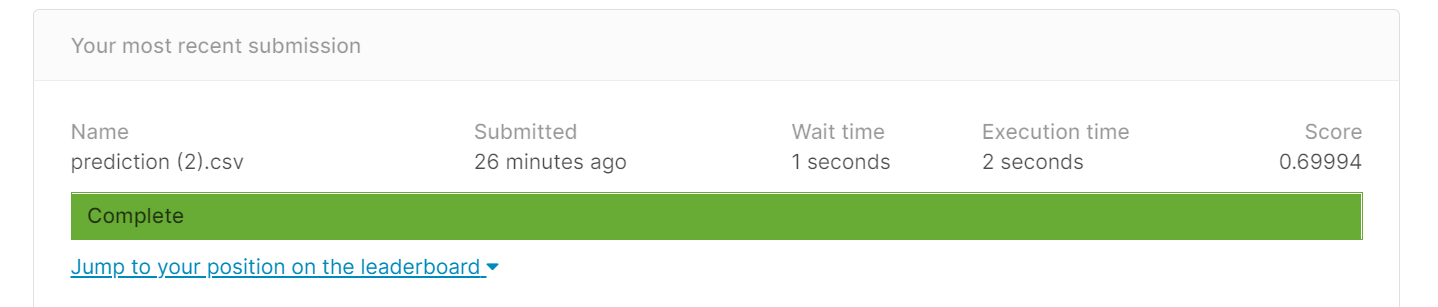
总结
我将Sigmoid替换为了ReLU之后,上升了一丢丢,不知道为什么调整了比例和lr后,training模拟的很好,但是validation问题就很大…可能是他的网络的问题,但是我优化歪来,只能等以后再优化了。

魔乐社区(Modelers.cn) 是一个中立、公益的人工智能社区,提供人工智能工具、模型、数据的托管、展示与应用协同服务,为人工智能开发及爱好者搭建开放的学习交流平台。社区通过理事会方式运作,由全产业链共同建设、共同运营、共同享有,推动国产AI生态繁荣发展。
更多推荐


 1
1 0
0- 0


 已为社区贡献8条内容

所有评论(0)