【数据结构 C语言版】第三篇 单链表习题_数据结构c语言 单链表题
方法一代码题解(方法二)(1)翻转方向(2)代码实现细节图解方法二代码。

方法一代码
struct ListNode\* cur=head;
struct ListNode\* newhead=NULL;
while(cur)
{
    struct ListNode\* next=cur->next;
    cur->next=newhead;
    newhead=cur;
    cur=next;
}
return newhead;
题解(方法二)
(1)翻转方向

(2)代码实现细节图解

方法二代码
struct ListNode\* reverseList(struct ListNode\* head){
    struct ListNode\* n1,\*n2,\*n3;
    //防止链表为空n3赋值放在循环里面
    n1=NULL,n2=head,n3=NULL;
    while(n2)
    {
        n3=n2->next;
        n2->next=n1;

        //迭代
        n1=n2;
        n2=n3;
    }
    return n1;
}
3.链表的中间结点
题目

题解
(1)通过快慢指针,可以只遍历一遍链表就能得出正确答案
(2)快指针一次走两步,慢指针一次走一步,快指针走完链表,慢指针刚好在一半处。
(3)图解

代码
struct ListNode\* middleNode(struct ListNode\* head){
    //快慢指针
    struct ListNode\* f=head,\*s=head;
    //注意两个判断条件
    while(f&&f->next)
    {
        s=s->next;
        f=f->next->next;
    }
    return s;
}
4. 链表中倒数第k个结点
题目
[链表中倒数第k个结点_牛客题霸_牛客网 ](链表中倒数第k个结点_牛客题霸_牛客网 (nowcoder.com))

题解
(1)方法还是快慢指针
(2)fast先走一步,fast跟slow再同时走,最后slow停在的地方就是倒数第一个。
类推,fast先走k步,fast跟slow再同时走,最后slow停在的地方就是倒数第几个。
(3)图解:
注意
(1)为什么fast先走的循环中使用k–,使用–k可以吗?
代码while(k–),k–的含义:每次先用k,然后再自减。每次循环k的变化(以上图为例):3,2,1。当k==0的时候不执行。
当while(–k)时,–k的含义:每次用k的时候先自减。k的变化:2,1。导致就执行两次。
(2)链表可能为空需要判断。
代码
struct ListNode\* FindKthToTail(struct ListNode\* pListHead, int k ) {
    struct ListNode \*fast,\*slow;
    fast=slow=pListHead;
    //fast先走n步
    while(k--)
    {
        //当链表为空的时候,返回空值
        if(!fast)
        {
            return fast;
        }
        fast=fast->next;
    }
    //fast跟slow一直走到fast为空的时候
    while(fast)
    {
        fast=fast->next;
        slow=slow->next;
    }
    return slow;
}
5.合并两个有序链表
题目

题解
(1)写一个哨兵头,比大小,小的只管尾插,不需要考虑头插。
(2)图解

代码
struct ListNode\* mergeTwoLists(struct ListNode\* list1, struct ListNode\* list2){
    struct ListNode\* guard =(struct ListNode\*)malloc(sizeof(struct ListNode));
    struct ListNode\* cur1,\*cur2,\*newhead,\*cur3;
    guard->next=NULL;
    cur1=list1,cur2=list2,newhead=cur3=guard;
    //小的尾插
    while(cur1&&cur2)
    {
        if(cur1->val>=cur2->val)
        {
            cur3->next=cur2;
            cur3=cur3->next;
            cur2=cur2->next;
        }
        else
        {
            cur3->next=cur1;
            cur3=cur3->next;
            cur1=cur1->next;
        }
    }
    //剩余的尾插
    if(cur1)
    {
        while(cur1)
        {
          cur3->next=cur1;
            cur3=cur3->next;
            cur1=cur1->next;
        }
    }
    else
    {
        while(cur2)
        {
            cur3->next=cur2;
            cur3=cur3->next;
            cur2=cur2->next;
        }
    }
    //释放哨兵结点,更新newhead的位置
    newhead=guard->next;
    free(guard);
    return newhead;
}
6.给定值x为基准将链表分割
编写代码,以给定值x为基准将链表分割成两部分,所有小于x的结点排在大于或等于x的结
点之前
题目
[链表分割](链表分割_牛客题霸_牛客网 (nowcoder.com))

题解
(1)创建两个哨兵结点,一个哨兵结点(暂且叫它lessGuard)后面插入的是小于x值的结点,另一个哨兵结点(叫它greaterGuard)后面插入的是大于x值的结点。
(2)过程图解:

注意
(1)greaterGuard指向的那条链表最后一个结点的next为什么要处理?
如果greaterGuard指向的那条链表的最后一个结点在原链表中不是最后一个结点的话,那么就会指向lessGuard指向的链表中的最后一个结点,如图所示:

两个链表合并的话就会出现下面这张图的情况,即形成一个环:
代码
    ListNode\* partition(ListNode\* pHead, int x) {
        // write code here

        //lessGuard:小于x的结点的链表的哨兵头,lessTail:用于操作链表
        //greaterGuard:大于x的结点的链表的哨兵头,greaterTail:用于操作链表
        //tail用于遍历原链表
        struct ListNode \*lessGuard,\*lessTail,\*greaterGuard,\*greaterTail,\*tail;
        lessGuard=(struct ListNode\*)malloc(sizeof(struct ListNode));
        greaterGuard=(struct ListNode\*)malloc(sizeof(struct ListNode));
        lessTail=lessGuard;
        greaterTail=greaterGuard;
        tail=pHead;
        //结点根据大小尾插到相应的链表后面
        while(tail)
        {
            if(tail->val<x)
            {
                lessTail->next=tail;
                tail=tail->next;
                lessTail=lessTail->next;
            }
            else
            {
                greaterTail->next=tail;
                tail=tail->next;
                greaterTail=greaterTail->next;
            }
        }
        //最后两个链表合并
        lessTail->next=greaterGuard->next;
        //greaterTail->next后面应该是NULL
        //否则可能形成环
        greaterTail->next=NULL;
        pHead=lessGuard->next;
        //释放掉两个哨兵结点
        free(greaterGuard);
        free(lessGuard);
        return pHead;
    }
7. 链表的回文结构
题目
[链表的回文结构](链表的回文结构_牛客题霸_牛客网 (nowcoder.com))

题解
(1)可以先用快慢指针,找出链表的中间点,然后将后半段链表反转,最后两个链表进行比较。
(2)这题可以看成是第2题与第3题的结合。
(3)图解

代码
bool chkPalindrome(ListNode\* A) {
        // write code here
        struct ListNode\* f,\*s;
        f=s=A;
        while(f&&f->next)
        {
            f=f->next->next;
            s=s->next;
        }

        struct ListNode \*cur=s, \*n = NULL;
        while(cur)
        {
            struct ListNode\* next=cur->next;
            cur->next=n;
            n=cur;
            cur=next;
        }

        struct ListNode \*cur1=A;
        while(n&&cur1)
        {
            if(n->val!=cur1->val)
            {
                return false;
            }
                n=n->next;
                cur1=cur1->next;
        }
        return true;
    }
8.相交链表
输入两个链表,找出它们的第一个公共结点。
题目

题解
(1)a.先可以遍历一遍,如果两个链表尾结点的地址相同就说明两个链表相交。反之,则不想交。
b.通过a步骤的遍历,分别求出两个链表的长度,然后 长度长的链表先走差距步(两个链表的长度差)。走完之后,同时走,第一个地址相等的结点就是相交结点。
(2)图解:

代码
struct ListNode \*getIntersectionNode(struct ListNode \*headA, struct ListNode \*headB) {
    //1.分别遍历
    struct ListNode\* curA,\*curB;
    curA=headA,curB=headB;
    //遍历判断条件是结点下一个不为空
    //防止空结点
    if(headA==NULL||headB==NULL)
    {
        return NULL;
    }
    //len要从1开始
    int lenA=1,lenB=1;

    while(curA->next)
    {
        lenA++;
        curA=curA->next;
    }
    while(curB->next)
    {
        lenB++;
        curB=curB->next;
    }
    //如果不相等就返回空
    if(curA!=curB)
    {
        return NULL;
    }
    //2.长的走差距步
    //默认长链表是A,短链表是B(可以少写判断)
    struct ListNode\* longList = headA,\*shortList = headB;
    if(lenB>lenA)
    {
        longList=headB;
        shortList=headA;
    }
    //差距步总不能是负的吧
    int gap = abs(lenA-lenB);
    while(gap--)
    {
        longList=longList->next;
    }
    //3.开始同时走
    while(longList!=shortList)
    {
        longList=longList->next;
        shortList=shortList->next;
    }
    return longList;
}
9.判断链表中是否有环
给定一个链表,判断链表中是否有环。
题目

题解
(1)快慢指针,即慢指针一次走一步,快指针一次走两步,两个指针从链表其实位置开始运行,
如果链表带环则一定会在环中相遇,否则快指针率先走到链表的末尾。比如:陪女朋友到操作跑步减肥。
(2)注意:这题切不能遍历,一遍历就死循环。
(3)图解:

注意
关于这题的问题请看这篇文章:深入理解快慢指针算法 – 链表环路检测 - 知乎 (zhihu.com)
代码
bool hasCycle(struct ListNode \*head) {
    struct ListNode\* fast,\*slow;
    fast=slow=head;
    while(fast&&fast->next)
    {
        slow=slow->next;
        fast=fast->next->next;
        if(fast==slow)
        return true;
    }
    return false;
}
10. 返回链表开始入环的第一个结点
给定一个链表,返回链表开始入环的第一个结点。 如果链表无环,则返回 NULL
题目

题解:


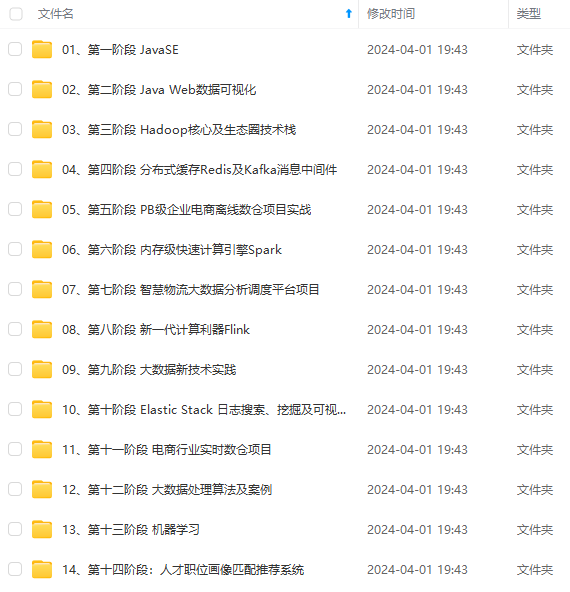
既有适合小白学习的零基础资料,也有适合3年以上经验的小伙伴深入学习提升的进阶课程,涵盖了95%以上大数据知识点,真正体系化!
由于文件比较多,这里只是将部分目录截图出来,全套包含大厂面经、学习笔记、源码讲义、实战项目、大纲路线、讲解视频,并且后续会持续更新
ast->next->next;
if(fast==slow)
return true;
}
return false;
}
###### 10. 返回链表开始入环的第一个结点
给定一个链表,返回链表开始入环的第一个结点。 如果链表无环,则返回 NULL
>
> 题目
>
>
>
[142. 环形链表 II](https://bbs.csdn.net/topics/618545628)

>
> 题解:
[外链图片转存中...(img-t7vwHYbP-1714447308416)]
[外链图片转存中...(img-cqxYG7f5-1714447308417)]
[外链图片转存中...(img-hAkXayno-1714447308417)]
**既有适合小白学习的零基础资料,也有适合3年以上经验的小伙伴深入学习提升的进阶课程,涵盖了95%以上大数据知识点,真正体系化!**
**由于文件比较多,这里只是将部分目录截图出来,全套包含大厂面经、学习笔记、源码讲义、实战项目、大纲路线、讲解视频,并且后续会持续更新**
**[需要这份系统化资料的朋友,可以戳这里获取](https://bbs.csdn.net/topics/618545628)**

魔乐社区(Modelers.cn) 是一个中立、公益的人工智能社区,提供人工智能工具、模型、数据的托管、展示与应用协同服务,为人工智能开发及爱好者搭建开放的学习交流平台。社区通过理事会方式运作,由全产业链共同建设、共同运营、共同享有,推动国产AI生态繁荣发展。
更多推荐



 15
15 0
0- 0


 已为社区贡献4条内容

所有评论(0)