利用多层感知机MLP实现GAN网络(pytorch版)
生成对抗网络(Generative Adversarial Network, GAN)是由 Ian Goodfellow 等人在 2014 年 提出的一种深度学习模型,主要用于生成逼真的数据(如图像、音频、文本等)。GAN 的核心思想是通过两个神经网络相互对抗(生成器 vs. 判别器)来提升生成数据的质量。
GAN:Generative Adversarial Nets
- 一、理论部分
-
- 1.1 基本原理
- 1.2 损失函数
- 1.3 训练流程
- 1.4 GAN的常见问题与解决方案
- 1.5 进阶方向
- 二、代码实现
-
- 2.1 导包
- 2.2 数据加载和处理
- 2.3 构建生成器
- 2.4 构建判别器
- 2.5 训练和保存模型
- 2.6 训练生成过程
- 2.7 模型加载和生成
一、理论部分
相关论文:Generative Adversarial Nets摘要:We propose a new framework for estimating generative models via an adversar-ial process, in which we simultaneously train two models: a generative model G that captures the data distribution, and a discriminative model D that estimates the probability that a sample came from the training data rather than G. The train-ing procedure for G is to maximize the probability of D making a mistake. This framework corresponds to a minimax two-player game. In the space of arbitrary functions G and D, a unique solution exists, with G recovering the training data distribution and D equal to everywhere. In the case where G and D are defined by multilayer perceptrons, the entire system can be trained with backpropagation. There is no need for any Markov chains or unrolled approximate inference net-works during either training or generation of samples. Experiments demonstrate the potential of the framework through qualitative and quantitative evaluation of thegenerated samples.
1.1 基本原理
生成对抗网络(Generative Adversarial Network, GAN)是由 Ian Goodfellow 等人在 2014 年 提出的一种深度学习模型,主要用于生成逼真的数据(如图像、音频、文本等)。
GAN 的核心思想是通过两个神经网络相互对抗(生成器 vs. 判别器)来提升生成数据的质量。
- 生成器(Generator):将随机噪声转换为逼真数据(如图像)
- 判别器(Discriminator):区分真实数据与生成数据
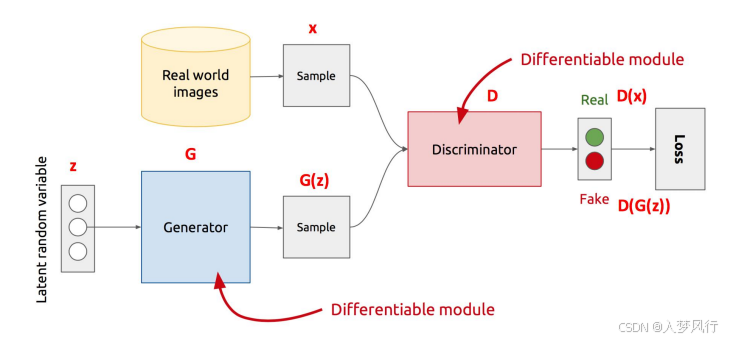
二者通过对抗训练共同提升,最终生成器能生成以假乱真的数据
1.2 损失函数
- 判别器损失:
L D = − E x ∼ p d a t a [ log D ( x ) ] − E z ∼ p z [ log ( 1 − D ( G ( z ) ) ) ] L_D = -\mathbb{E}_{x \sim p_{data}}[\log D(x)] - \mathbb{E}_{z \sim p_z}[\log(1 - D(G(z)))] LD=−Ex∼pdata[logD(x)]−Ez∼pz[log(1−D(G(z)))] - 生成器损失:
L G = − E z ∼ p z [ log D ( G ( z ) ) ] (或使用 L G = E z ∼ p z [ log ( 1 − D ( G ( z ) ) ) ] L_G = -\mathbb{E}_{z \sim p_z}[\log D(G(z))] \quad \text{(或使用 } L_G = \mathbb{E}_{z \sim p_z}[\log(1 - D(G(z)))] LG=−Ez∼pz[logD(G(z))](或使用 LG=Ez∼pz[log(1−D(G(z)))]
1.3 训练流程
1.4 GAN的常见问题与解决方案
| 问题 | 原因 | 解决方案 |
|---|---|---|
| 模式崩溃(Mode Collapse) | 生成器只生成少数样本 | 使用Mini-batch Discriminator |
| 训练不稳定 | 梯度消失/爆炸 | WGAN-GP,TTUR |
| 生成质量差 | 网络容量不足 | 使用更深网络(如DCGAN) |
1.5 进阶方向
- Conditional GAN:加入标签信息控制生成内容
- CycleGAN:无配对图像风格转换
- StyleGAN:高分辨率人脸生成
通过调整网络结构和训练策略,GAN可应用于图像生成、超分辨率、数据增强等多个领域
二、代码实现
2.1 导包
import torch
import torch.nn as nn
from torch.utils.data import DataLoader
from torchvision import datasets, transforms
from torchvision.utils import save_image

import os
import numpy as np
import matplotlib.pyplot as plt
from tqdm.notebook import tqdm
from torchsummary import summary

# 判断是否存在可用的GPU
device=torch.device("cuda:0" if torch.cuda.is_available() else "cpu")
2.2 数据加载和处理
# 加载 MNIST 数据集
def load_data(batch_size=64,img_shape=(1,28,28)):
    transform = transforms.Compose([
        transforms.Resize((img_shape[1],img_shape[2])),
        transforms.ToTensor(),  # 将图像转换为张量
        transforms.Normalize((0.5,), (0.5,))  # 归一化
    ])

    # 下载训练集和测试集
    train_dataset = datasets.MNIST(root='./data', train=True, download=True, transform=transform)
    test_dataset = datasets.MNIST(root='./data', train=False, download=True, transform=transform)

    # 创建 DataLoader
    train_loader = DataLoader(dataset=train_dataset, batch_size=batch_size, shuffle=True)
    test_loader = DataLoader(dataset=test_dataset, batch_size=batch_size, shuffle=False)
    return train_loader, test_loader
2.3 构建生成器
latent_dim 是生成对抗网络(GAN)中一个关键的超参数,表示 潜在空间(Latent Space)的维度,即生成器输入噪声向量的长度。
1. 核心概念
- 定义:
latent_dim决定了生成器输入噪声向量z的维度(通常为100-512维)- 数学表示: z ∈ R l a t e n t _ dim ℝ^{latent\_\dim} Rlatent_dim,例如
latent_dim=100时,z是一个100维的随机向量- 作用: 控制生成器输入的自由度,影响生成样本的多样性和质量
2. 典型取值
| 应用场景 | 推荐值 | 说明 |
|---|---|---|
| 小型图像(28x28) | 50-100 | MNIST/Fashion-MNIST等 |
| 中型图像(128x128) | 100-256 | CIFAR-10/小型人脸数据集 |
| 高清图像(256x256+) | 256-512 | CelebA/HQ等 |
3. 调整建议
-
增大
latent_dim:- 👍 提高生成多样性
- 👎 可能增加训练难度(需更多数据/更长训练时间)
-
减小
latent_dim:- 👍 加速训练,降低模式崩溃风险
- 👎 可能限制生成能力
4. 与其他参数的关系
| 参数 | 交互影响 |
|---|---|
batch_size |
大batch需配合足够大的latent_dim |
generator_capacity |
高容量生成器可支持更大维度 |
dataset_complexity |
复杂数据集需要更高维度 |
5. 可视化理解
7. 研究支持
通过合理调整 latent_dim,你可以平衡生成质量与训练效率。通常建议从 100 开始,根据生成效果逐步调整
class Generator(nn.Module):
    """生成器"""
    def __init__(self, latent_dim=100, img_shape=(1,28,28)):
        super(Generator,self).__init__()
        self.img_shape = img_shape  # 存储目标图片形状

        # 网络块
        def block(in_feat,out_feat,normalize=True):
            layers=[nn.Linear(in_feat,out_feat)]
            if normalize:
                #实践发现:对于生成器,较高的动量(如0.5-0.8)有时能提升生成多样性
                layers.append(nn.BatchNorm1d(out_feat,momentum = 0.8))
            layers.append(nn.LeakyReLU(negative_slope=0.2,inplace=True))
            return layers

        self.model = nn.Sequential(
            *block(latent_dim, 128,normalize=False),   # 输入:latent_dim维噪声
            *block(128, 256),
            *block(256, 512),
            *block(512,1024),
            nn.Linear(1024, int(np.prod(img_shape))), # 输出形状[B,C*H*W]
            nn.Tanh()  # 输出归一化到[-1,1]
        )

    def forward(self, z):
        img=self.model(z) # [B,C*H*W],2维数据
        img=img.view(img.shape[0],*self.img_shape) # 2维->4维[B,C,H,W]
        return img
- 打印生成器模型结构(一)
model_G = Generator().to(device)
# 打印模型摘要
summary(model_G, input_size=(100,))
----------------------------------------------------------------
        Layer (type)               Output Shape         Param #
================================================================
            Linear-1                  [-1, 128]          12,928
         LeakyReLU-2                  [-1, 128]               0
            Linear-3                  [-1, 256]          33,024
       BatchNorm1d-4                  [-1, 256]             512
         LeakyReLU-5                  [-1, 256]               0
            Linear-6                  [-1, 512]         131,584
       BatchNorm1d-7                  [-1, 512]           1,024
         LeakyReLU-8                  [-1, 512]               0
            Linear-9                 [-1, 1024]         525,312
      BatchNorm1d-10                 [-1, 1024]           2,048
        LeakyReLU-11                 [-1, 1024]               0
           Linear-12                  [-1, 784]         803,600
             Tanh-13                  [-1, 784]               0
================================================================
Total params: 1,510,032
Trainable params: 1,510,032
Non-trainable params: 0
----------------------------------------------------------------
Input size (MB): 0.00
Forward/backward pass size (MB): 0.05
Params size (MB): 5.76
Estimated Total Size (MB): 5.82
----------------------------------------------------------------
- 打印生成器模型结构(二)
z = torch.randn(64,100).to(device)
for layer in model_G.model:
    z=layer(z)
    print(f"{layer.__class__.__name__} --> Output shape={tuple(z.shape)}")
Linear --> Output shape=(64, 128)
LeakyReLU --> Output shape=(64, 128)
Linear --> Output shape=(64, 256)
BatchNorm1d --> Output shape=(64, 256)
LeakyReLU --> Output shape=(64, 256)
Linear --> Output shape=(64, 512)
BatchNorm1d --> Output shape=(64, 512)
LeakyReLU --> Output shape=(64, 512)
Linear --> Output shape=(64, 1024)
BatchNorm1d --> Output shape=(64, 1024)
LeakyReLU --> Output shape=(64, 1024)
Linear --> Output shape=(64, 784)
Tanh --> Output shape=(64, 784)
2.4 构建判别器
class Discriminator(nn.Module):
    """判别器"""
    def __init__(self,img_shape=(1,28,28)):
        super(Discriminator, self).__init__()

        self.model = nn.Sequential(
            nn.Linear(int(np.prod(img_shape)), 512),
            nn.LeakyReLU(0.2, inplace=True),
            nn.Linear(512, 256),
            nn.LeakyReLU(0.2, inplace=True),
            nn.Linear(256, 1),
            # nn.Sigmoid(), 无需归一到[0,1](概率值),
            # 使用nn.BCEWithLogitsLoss(),它结合了 Sigmoid + BCELoss,且数值更稳定
        )

    def forward(self, img):
        # 将输入图片展平
        img_flat = img.view(img.size(0), -1) # 4维[B,C,H,W]->2维[B,C*H*W]

        # 样本的真实性
        validity = self.model(img_flat)
        return validity # [B,1]
- 打印判别器模型结构(一)
model_D = Discriminator().to(device)
# 打印模型摘要
summary(model_D, input_size=(1,28,28))
----------------------------------------------------------------
        Layer (type)               Output Shape         Param #
================================================================
            Linear-1                  [-1, 512]         401,920
         LeakyReLU-2                  [-1, 512]               0
            Linear-3                  [-1, 256]         131,328
         LeakyReLU-4                  [-1, 256]               0
            Linear-5                    [-1, 1]             257
================================================================
Total params: 533,505
Trainable params: 533,505
Non-trainable params: 0
----------------------------------------------------------------
Input size (MB): 0.00
Forward/backward pass size (MB): 0.01
Params size (MB): 2.04
Estimated Total Size (MB): 2.05
----------------------------------------------------------------
- 打印判别器模型结构(二)
img = torch.randn(64,1,28,28).to(device)
# 将输入图片展平
img = img.view(img.size(0), -1) # 4维[B,C,H,W]->2维[B,C*H*W]
for layer in model_D.model:
    img=layer(img)
    print(f"{layer.__class__.__name__} --> Output shape={tuple(img.shape)}")
Linear --> Output shape=(64, 512)
LeakyReLU --> Output shape=(64, 512)
Linear --> Output shape=(64, 256)
LeakyReLU --> Output shape=(64, 256)
Linear --> Output shape=(64, 1)
2.5 训练和保存模型
# 设置超参数
batch_size = 64
epochs = 200
lr= 2e-4
latent_dim=100 # 生成器输入噪声向量的长度(维数)
sample_interval=400 #每400次迭代保存生成样本

os.makedirs("./img/gan_mlp_mnist", exist_ok=True) # 存放生成样本目录
os.makedirs("./model", exist_ok=True) #模型存放目录

# 设置图片形状1*28*28
img_c,img_h,img_w=1,28,28
img_shape = (img_c,img_h,img_w)

# 加载数据
train_loader,_= load_data(batch_size=batch_size,img_shape=img_shape)

# 实例化生成器G、判别器D
G=Generator().to(device)
D=Discriminator().to(device)


# 设置优化器
optimizer_G = torch.optim.Adam(G.parameters(), lr=lr, betas=(0.5, 0.999))
optimizer_D = torch.optim.Adam(D.parameters(), lr=lr, betas=(0.5, 0.999))

# 损失函数
loss_fn=nn.BCEWithLogitsLoss()

# 开始训练
loader_len=len(train_loader) #训练加载器的长度
for epoch in range(epochs):
     #记录生成器G和判别器D的总损失(1个 epoch 内)
    gen_loss_sum,dis_loss_sum=0.0,0.0

    loop = tqdm(train_loader, desc=f"第{epoch+1}轮")
    for i, (real_imgs, _) in enumerate(loop):
        real_imgs=real_imgs.to(device)  # [B,C,H,W]
        # -----------------
        #  训练生成器
        # -----------------

        # 获取噪声样本[B,latent_dim]
        z=torch.normal(0,1,size=(real_imgs.shape[0],latent_dim),device=device)  #从正态分布中抽样

        # 更新生成器参数
        optimizer_G.zero_grad() #梯度清零
        gen_imgs=G(z) #生成一个批量的图片
        gen_loss=loss_fn(D(gen_imgs),torch.ones_like(D(gen_imgs))) #计算生成器损失
        gen_loss.backward() #反向传播,计算梯度
        optimizer_G.step()  #更新生成器

        # -----------------
        #  训练判断器
        # -----------------
        optimizer_D.zero_grad() #梯度清零

        # 计算判断器损失=(判断真实图片损失+判断生成图片损失)/2
        real_loss=loss_fn(D(real_imgs),torch.ones_like(D(real_imgs)))
        fake_loss=loss_fn(D(gen_imgs.detach()),torch.zeros_like(D(gen_imgs.detach())))
        dis_loss=(real_loss+fake_loss)/2.0

        # 更新判断器参数
        dis_loss.backward() #反向传播,计算梯度
        optimizer_D.step()  #更新判断器


        # 对生成器和判别器每次迭代的损失进行累加
        gen_loss_sum+=gen_loss
        dis_loss_sum+=dis_loss

        # 每 sample_interval 次迭代保存生成样本
        batches_done = epoch * loader_len + i
        if batches_done % sample_interval == 0:
            save_image(gen_imgs.data[:25], f"./img/gan_mlp_mnist/{epoch}_{i}.png", nrow=5, normalize=True)
            # 更新进度条
            loop.set_postfix(mean_gen_loss=f"{gen_loss_sum/(loop.n + 1):.8f}",mean_dis_loss=f"{dis_loss_sum/(loop.n + 1):.8f}")


#仅保存模型的参数(权重和偏置),灵活性高,可以在不同的模型结构之间加载参数
torch.save(G.state_dict(), "./model/G_MLP.pth")
torch.save(D.state_dict(), "./model/D_MLP.pth")
2.6 训练生成过程
from PIL import Image

def create_gif(img_dir="./img/gan_mlp_mnist", output_file="./img/gan_mlp_mnist/gen_figure.gif", duration=100):
    images = []
    img_paths = [f for f in os.listdir(img_dir) if f.endswith(".png")]

    # 自定义排序:按 "x_y.png" 的 x 和 y 排序
    img_paths_sorted = sorted(
        img_paths,
        key=lambda x: (
            int(x.split('_')[0]),  # 第一个数字(如 0_400.png 的 0)
            int(x.split('_')[1].split('.')[0])  # 第二个数字(如 0_400.png 的 400)
        )
    )

    for img_file in img_paths_sorted:
        img = Image.open(os.path.join(img_dir, img_file))
        images.append(img)

    images[0].save(output_file, save_all=True, append_images=images[1:],
                  duration=duration, loop=0)
    print(f"GIF已保存至 {output_file}")
create_gif()
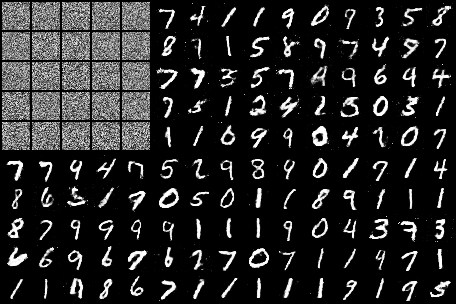
2.7 模型加载和生成
#载入训练好的模型
G = Generator() # 定义模型结构
G.load_state_dict(torch.load("./model/G_MLP.pth",weights_only=True,map_location=device)) # 加载保存的参数
G.to(device) # 将模型移动到设备(GPU 或 CPU)
G.eval() # 将模型设置为评估模式

#抽取噪声数据
z=torch.normal(0,1,size=(10,100),device=device)
#生成假样本
gen_img=G(z).view(-1,28,28) # 4维->3维
gen_img=gen_img.detach().cpu().numpy()

#绘制
for i in range(10):
    plt.subplot(2,5,i+1)
    plt.xticks([], [])
    plt.yticks([], [])
    plt.imshow(gen_img[i])
    plt.gray()
plt.show()
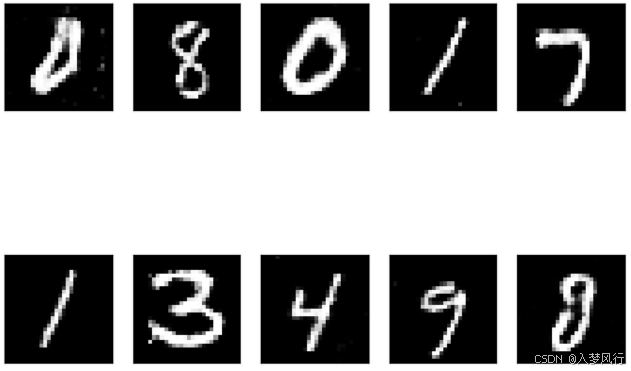

魔乐社区(Modelers.cn) 是一个中立、公益的人工智能社区,提供人工智能工具、模型、数据的托管、展示与应用协同服务,为人工智能开发及爱好者搭建开放的学习交流平台。社区通过理事会方式运作,由全产业链共同建设、共同运营、共同享有,推动国产AI生态繁荣发展。
更多推荐


 10
10 0
0- 0


 已为社区贡献6条内容

所有评论(0)