track fusion matlab,Introduction to Track-To-Track Fusion
Track-To-Track Fusion Versus Central-Level Tracking
A multiple sensor tracking system can provide better performance than a single sensor
system because it can provide broader coverage and better visibility. Moreover, fusing
detections from different types of sensors can also improve the quality and accuracy of
the target estimates. Two types of architecture are commonly used in a multiple sensor
tracking system. In the first type of architecture — central-level tracking — the
detections from all the sensors are sent directly to a tracking system that maintains
tracks based on all the detections. Theoretically, the central-level tracking
architecture can achieve the best performance because it can fully use all the
information contained in the detections. However, you can also apply a hierarchical
structure with sensor-level tracking combined with track-level fusion for a multiple
sensor system. The figure shows a typical central-level tracking system and a typical
track-to-track fusion system based on sensor-level tracking and track-level fusion.
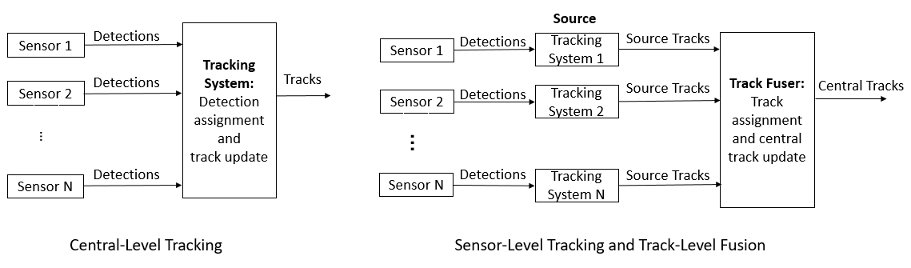
To represent each element in a track-to-track fusion system, call tracking systems
that output tracks to a fuser as sources, and call the outputted tracks from sources as
source tracks or local tracks. Call the tracks maintained in the fuser as central
tracks.

魔乐社区(Modelers.cn) 是一个中立、公益的人工智能社区,提供人工智能工具、模型、数据的托管、展示与应用协同服务,为人工智能开发及爱好者搭建开放的学习交流平台。社区通过理事会方式运作,由全产业链共同建设、共同运营、共同享有,推动国产AI生态繁荣发展。
更多推荐


 0
0 0
0- 0


 已为社区贡献4条内容

所有评论(0)