四、语义分析,《编译原理》(本科教学版),第2版
语义分析的任务是什么?
文章目录
一、手写符号表
语义分析阶段有两个比较关键的任务:
类型检查
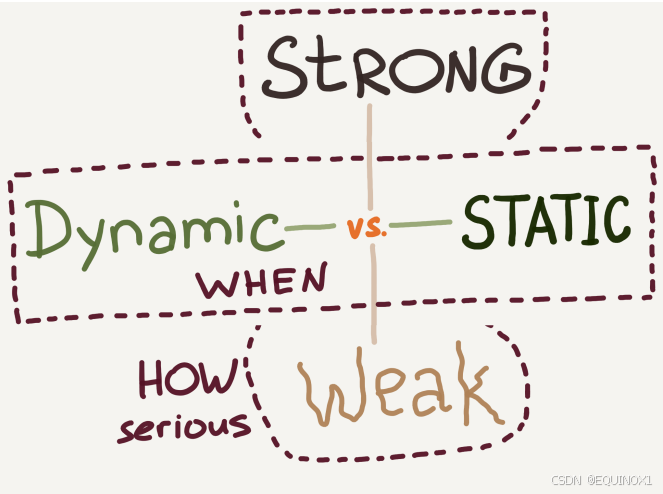
对于 statically-typed language,如 java,c++,C#,Go,我们可以在编译期 确定变量类型
对于 Dynamically-typed language,如 python,javascript,php,ruby,类型在运行时确定
相应的,我们也可以根据类型检查强弱 来划分为 强类型 / 弱类型 语言。
比如 以安全性著称的 rust,就非常的严格(简直在防止程序员写代码)
符号检查
符号:变量名,函数名,类型名,标签名……
比如下面这段有问题的代码:
int one = 1;
int three = one + two;	// undefined
int five = len("Hello");	// undefined

int two = one(one);	// 错误地把int 当作函数来用
int one = 1;		// 重复定义
语义分析阶段,我们就要找出上面这些符号上的错误
我们在这个阶段需要建立符号表。
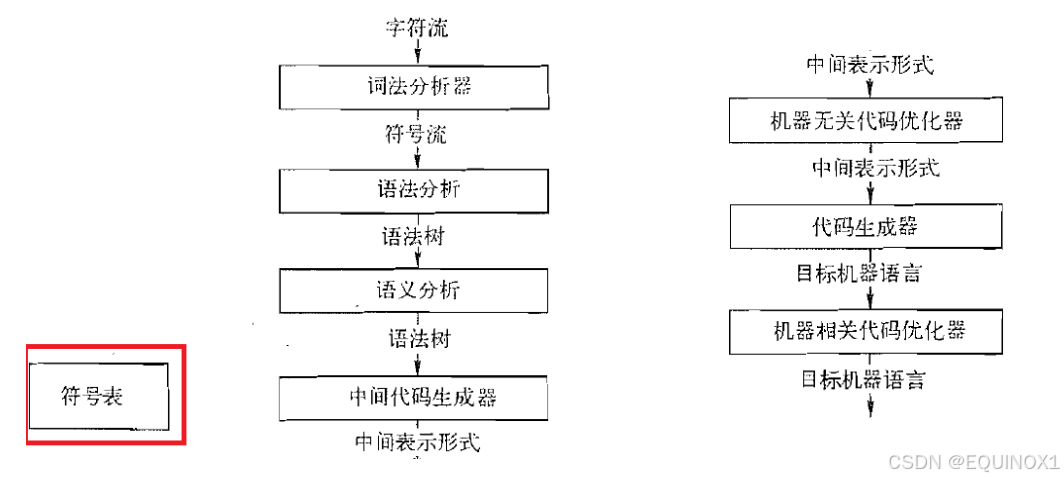
1.1 符号表
符号表(Symbol Table)是用于保存各种符号相关信息的数据结构。

“领域特定语言”(DSL)通常只有单作用域(全局作用域)
host = antlr.org;
port = 80;
webmaster = parrt@antlr.org;
对于这种语言我们用一个哈希表记录符号信息即可。
“通用程序设计语言”(GSL)通常需要嵌套作用域
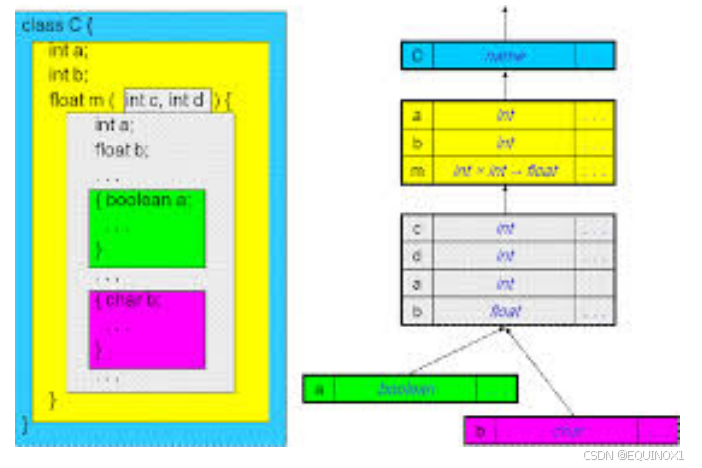
这个时候我们就需要多个哈希表,它们之间呈现一种树状结构。
比如下面这段代码对应的符号表:
int x;
int y;

void a(){
    int x;
    x = 1
    y = 2;
    { int y = x; }
}
void b(int z)
{}
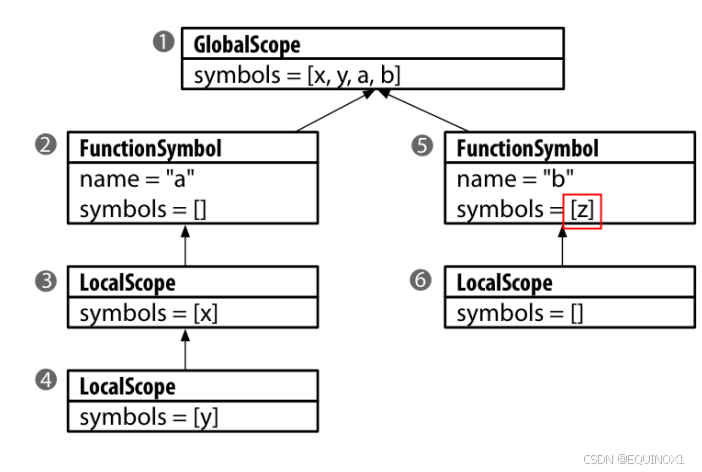
这张表的建立非常简单,我们还是使用监听器模式,递归的时候在进入和离开的时候进行控制即可。
1.2 手写符号表
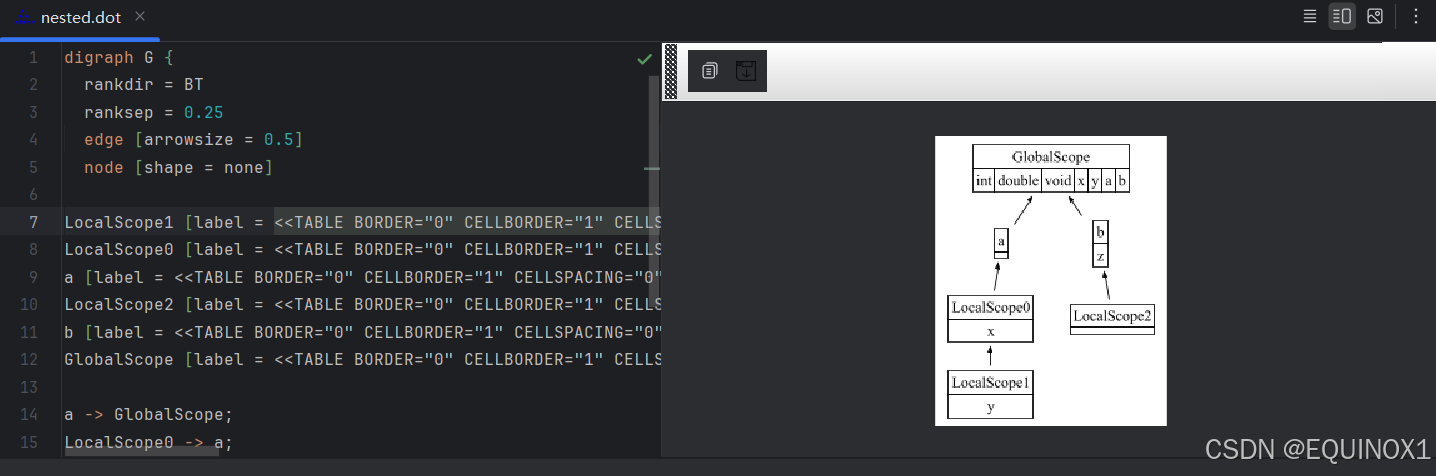
我们下面基于之前的 Cymbol.g4 中 的文法定义,来实现在dfs时建立如上面这种树形符号表关系。
1.2.1 需要的类
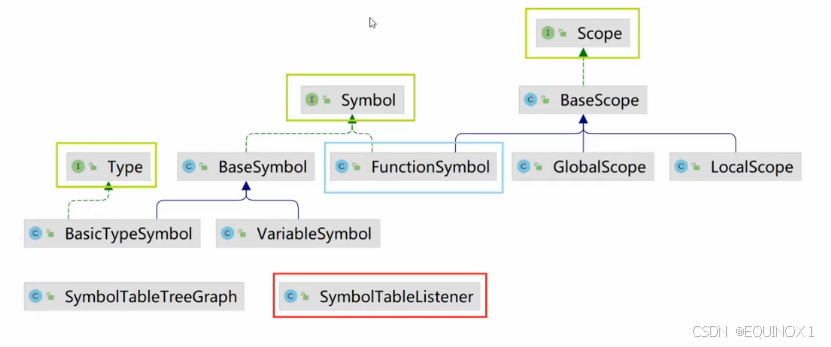
类间派生关系如上图
1.2.2 类的定义
Type
package symtable;

public interface Type {
}
Symbol
package symtable;

public interface Symbol {
  String getName();
}
BaseSymbol
package symtable;

import com.google.common.base.MoreObjects;

public class BaseSymbol implements Symbol {
  final String name;
  final Type type;

  public BaseSymbol(String name, Type type) {
    this.name = name;
    this.type = type;
  }

  public String getName() {
    return name;
  }

  public Type getType() {
    return type;
  }

  public String toString() {
    return MoreObjects.toStringHelper(this)
        .add("name", name)
        .add("type", type)
        .toString();
  }
}
FuntionSymbol
package symtable;

public class FunctionSymbol extends BaseScope implements Symbol {
  public FunctionSymbol(String name, Scope enclosingScope) {
    super(name, enclosingScope);
  }
}
Scope
package symtable;

import java.util.Map;

public interface Scope {
  String getName();
  void setName(String name);

  Map<String, Symbol> getSymbols();

  // 父作用域
  Scope getEnclosingScope();
  // 定义符号
  void define(Symbol symbol);
  // 解析
  Symbol resolve(String name);
}
GlobalScope
全局作用域默认添加了几个symbol
package symtable;

public class GlobalScope extends BaseScope {
  public GlobalScope(Scope enclosingScope) {
    super("GlobalScope", enclosingScope);

    define(new BasicTypeSymbol("int"));
    define(new BasicTypeSymbol("double"));
    define(new BasicTypeSymbol("void"));
  }
}
LocalScope
package symtable;

public class LocalScope extends BaseScope {
  private static int localScopeCounter = 0;

  public LocalScope(Scope enclosingScope) {
    super("LocalScope", enclosingScope);

    String localScopeName = getName() + localScopeCounter;
    setName(localScopeName);
    localScopeCounter++;
  }
}
1.2.3 BaseScope
BaseScope 作为 作用域的基类,需要符号表symbols,父作用域enclosingScope,名称name
symbols 就是一个简单的Map
package symtable;

import com.google.common.base.MoreObjects;

import java.util.LinkedHashMap;
import java.util.Map;

public class BaseScope implements Scope {
  private String name;
  private final Map<String, Symbol> symbols = new LinkedHashMap<>();
  private final Scope enclosingScope;

  public BaseScope(String name, Scope enclosingScope) {
    this.name = name;
    this.enclosingScope = enclosingScope;
  }

  @Override
  public String getName() {
    return this.name;
  }

  @Override
  public void setName(String name) {
    this.name = name;
  }

  @Override
  public Scope getEnclosingScope() {
    return this.enclosingScope;
  }

  public Map<String, Symbol> getSymbols() {
    return this.symbols;
  }

  @Override
  public void define(Symbol symbol) {
    this.symbols.put(symbol.getName(), symbol);
    System.out.println("+" + symbol);
  }

  @Override
  public Symbol resolve(String name) {
    Symbol symbol = this.symbols.get(name);
    if (symbol != null) {
      System.out.println("-" + name);
      return symbol;
    }

    // 往根节点找
    if (this.enclosingScope != null) {
      return this.enclosingScope.resolve(name);
    }

    // error
    System.out.println("?" + name);
    return null;
  }

  @Override
  public String toString() {
    return MoreObjects.toStringHelper(this)
        .add("name", name)
        .add("symbols", symbols.values().toString())
        .toString();
  }
}
需要注意的就是 define 和 resolve 的实现
define 只需向 符号表中添加 <name,symbol> 键值对
resolve 只需向 符号表中解析 name 对应的符号,如果自己的符号表有,那么就返回
否则向父作用域找
1.2.4 SymbolTableListener
Cymbol.g4
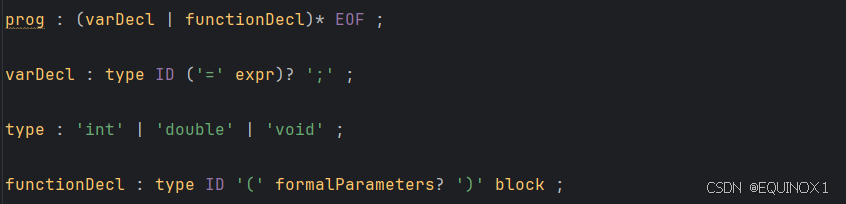
符号表监听器的逻辑分为四部分:
- 进入时 创建作用域,并切换当前作用域
- enterProg 进入 Prog
- enterBlock 进入局部作用域
- enterFunctionDecl 函数声明
- 添加符号
- 离开变量声明时,exitVarDecl,添加符号到当前作用域的符号表
- 离开参数列表时,exitFormalParameter,添加符号到当前作用域的符号表
- 使用符号
- 离开标识符时,exitId,标识符进行解析
- 离开作用域,返回其父作用域
- exitProg
- exitBlock
- exitFunctionDecl
package symtable;

import cymbol.CymbolBaseListener;
import cymbol.CymbolParser;

public class SymbolTableListener extends CymbolBaseListener {
  private GlobalScope globalScope = null;
  private Scope currentScope = null;

  private final SymbolTableTreeGraph graph = new SymbolTableTreeGraph();

  /**
   * (1) Create and enter a new scope
   */
  // 起始规则 开启全局作用域
  @Override
  public void enterProg(CymbolParser.ProgContext ctx) {
    globalScope = new GlobalScope(null);
    this.currentScope = globalScope;
  }

  // 开启作用域
  @Override
  public void enterBlock(CymbolParser.BlockContext ctx) {
    LocalScope localScope = new LocalScope(currentScope);

    graph.addEdge(localScope.getName(), currentScope.getName());

    currentScope = localScope;
  }

  // 函数声明
  @Override
  public void enterFunctionDecl(CymbolParser.FunctionDeclContext ctx) {
    String funcName = ctx.ID().getText();
    FunctionSymbol scope = new FunctionSymbol(funcName, currentScope);
    graph.addEdge(scope.getName(), currentScope.getName());

    currentScope.define(scope); // 加入 当前作用域符号表
    this.currentScope = scope;
  }

  /**
   * (2) define symbols
   */
  @Override
  public void exitVarDecl(CymbolParser.VarDeclContext ctx) {
    String typeName = ctx.type().getText();
    Type type = (Type) this.currentScope.resolve(typeName);

    String varName = ctx.ID().getText();

    VariableSymbol varSymbol = new VariableSymbol(varName, type);
    this.currentScope.define(varSymbol);
  }

  @Override
  public void exitFormalParameter(CymbolParser.FormalParameterContext ctx) {
    String typeName = ctx.type().getText();
    Type type = (Type) this.currentScope.resolve(typeName);

    String varName = ctx.ID().getText();

    VariableSymbol varSymbol = new VariableSymbol(varName, type);
    this.currentScope.define(varSymbol);
  }

   /**
   * (3) use symbols
   */
  @Override
  public void exitId(CymbolParser.IdContext ctx) {
    String varName = ctx.ID().getText();
    this.currentScope.resolve(varName);
  }

  /**
   * (4) Exit the current scope and return to its enclosing scope
   */

  @Override
  public void exitProg(CymbolParser.ProgContext ctx) {
    graph.addNode(SymbolTableTreeGraph.toDot(currentScope));
    currentScope = this.currentScope.getEnclosingScope();
  }

  @Override
  public void exitBlock(CymbolParser.BlockContext ctx) {
    graph.addNode(SymbolTableTreeGraph.toDot(currentScope));
    currentScope = this.currentScope.getEnclosingScope();
  }

  @Override
  public void exitFunctionDecl(CymbolParser.FunctionDeclContext ctx) {
    graph.addNode(SymbolTableTreeGraph.toDot(currentScope));
    currentScope = this.currentScope.getEnclosingScope();
  }

  public SymbolTableTreeGraph getGraph() {
    return graph;
  }
}
二、符号表
2.1 定义
- 用来存储程序中的变量相关信息
- 类型
- 作用域
- 访问控制信息
- 必须非常高效
- 程序中的变量规模会很大
2.2 符号表的接口
#ifndef TABLE_H
#def TABLE_H

typedef ... Table_t;	// 符号表的数据结构

// 新建符号表
Table_t Table_new ();
// 符号表的插入
void Table_enter (Table_t, Key_t, Value_t);
// 符号表的查找
Table_t Table_lookup (Table_t, Key_t);

#endif
2.3 符号表的典型数据结构
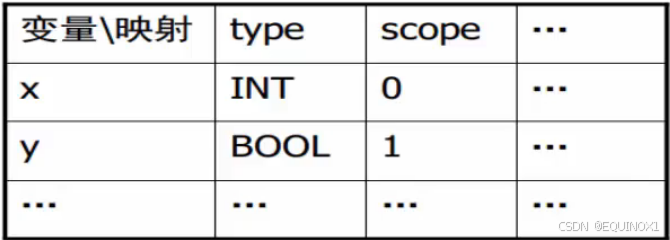
// 符号表是典型的字典结构
symbolTable: key->value;
// 一种简单的数据结构定义(概念上的):
typedef char *key;
typedef struct value{
    Type_t type;
    Scope_t scope;
    ... // 必要的其它字段
} value;
2.4 符号表的高效实现
- 为了高效,可以使用哈希表等数据结构来实现符号表
- 查找是O(1)时间
- 为了节约空间,也可以使用红黑树等平衡树
- 查找是**O(log N)**时间
2.5 作用域
int x;
int f() {
	if (4) {
        int x;
        x = 6;
    } else {
        int x;
        x = 5;
    }
    x = 8;
}
符号表处理作用域的方法
- 方法1:一张表的方法
- 进入作用域时,插入元素
- 退出作用域时,删除元素
如下:
int x;			 σ = (x->int)
int f() {		 σ1 = σ + (f->...) = {x->int, f->...}
	if (4) {
        int x;	 σ2 = σ1 = σ + (x->int) = {x->..., f->..., x->...}
        x = 6;
    }		 	σ1
    else {
        int x;	  σ4 = σ1 + {x->int} = {x->..., f->..., x->...}
        x = 5;
    }			σ1
    x = 8;
}				σ1
我们在 局部作用域 又定义了x,这要求我们在 符号表中实现变量的屏蔽
而 我们如果用哈希表来实现,开散列的结构,我们要将新的 x 在对应的链进行头插,这样保证我们对应桶的指针默认指向当前作用域中的对应变量
- 方法2:采用符号表构成的栈
- 进入作用域时,插入新的符号表
- 退出作用于时,删除栈顶符号表
这样很好的支持我们作用域的嵌套,栈顶始终是当前作用域的符号表
有点类似我们开始在anltr-v4 中的实现方式
2.6 名字空间
下面用到一个链表和 goto 语句
struct list{		// ①
    int x;
    struct list *list;		// ③
} *list;		// ②
				// ①  ②
void walk(struct list *list) {
    list: // ④
    	printf("%d\n", list->x);	// ②
    	if (list = list->list)		// ② ② ③
            goto list;			// ④
}
上面的代码中出现了很多次list,我们怎样去划分这些 list 呢?
2.7 用符号表处理名字空间
- 每个名字空间用一个表来处理
- 以C语言为例
- 有不同的名字空间:
- 变量 t1
- 标签 t2
- 标号 t3
- …
- 有不同的名字空间:
- 可以每一种定义一张符号表
2.8 基于符号表的类型检查算法
有如下文法:
E -> n
   | true
   | false
   | E + E
   | E && E
类型检查算法
enum type {INT, BOOL};
Table_t table;	// 符号表

enum type check_exp (Exp_ t e) {
	switch(e->kind)
		case EXP_INT: return INT;
		case EXP_TRUE: return BOOL;
		case EXP_FALSE: return BOOL;
		case EXP_ADD: t1 = check_exp(e->left);
					 t2 = check_exp(e->right);
					 if (t1 != INT || t2 != INT) {
					 	error("type mismatch");
					 else return INT;
}

enum type check_prog (Dec_t d, Exp_t e) {
	table = check_dec(d);
	return check_exp(e);
}

Table_t check_dec(Dec_t d) {
	foreach(T id ∈ d)
		table_enter(table, id, T);
}

enum type check_exp (Exp_ t e) {
	switch(e->kind)
		case EXP_ID:
			t = Table_lookup(table, id);
			if (id not exist)
				error("id not found");
			else return t;
}

void check_stm(Table_t table, Stm_t s) {
	switch(s->kind)
		case STM_ASSIGN:
			t1 = Table_lookup(s->id);
			t2 = check_exp(table, s->exp);
			if (t1 != t2)
				error("type mismatch");
			else return INT;
		case STM_PRINTI:
			t = check_exp(s->exp);
			if (t != INT)
				error("type mismatch");
			else return;
		case STM_PRINTB: ... // 类似
}
三、其它问题
语义分析中要考虑的其它问题:
- 类型相容性?
- 错误诊断?
- 代码翻译?
3.1 类型相等
-
类型检查问题往往归结为判断两个类型是否相等t1==t2?
- 在实际的语言中,这往往是个需要谨慎处理的复杂问题
-
示例1:名字相等vs结构相等
-
struct A { int i; } x; struct B { int i; } y; x = y; -
对采用名字相等的语言,可直接比较
- 上面 x 和 y 的类型 名称不同,所以赋值非法
-
对采用结构相等的语言,需要递归比较各个域
- 上面 A 和 B 的各个域的结构相等,无法 对 x = y 的错误做出检测
-
-
示例2:面向对象的继承
-
class A { int i; } class B extends A{ int i; } A x; B y; x = y; -
需要维护类型间的继承关系
-
3.2 错误诊断
- 要给出尽可能准确的错误信息
- 要给出尽可能多的错误信息
- 从错误中进行恢复
- 要给出尽可能准确的出错位置
- 程序代码的位置信息要从前端保留并传递过来
3.3 代码翻译
- 现代的编译器中的语义分析模块,除了做语义分析外,还要负责生成中间代码或目标代码
- 代码生成的过程也同样是对树的某种遍历
- 代码翻译将在后续讨论
- 因此,语义分析模块往往是编译器中最庞大也最复杂的模块

魔乐社区(Modelers.cn) 是一个中立、公益的人工智能社区,提供人工智能工具、模型、数据的托管、展示与应用协同服务,为人工智能开发及爱好者搭建开放的学习交流平台。社区通过理事会方式运作,由全产业链共同建设、共同运营、共同享有,推动国产AI生态繁荣发展。
更多推荐


 23
23 0
0- 0


 已为社区贡献3条内容

所有评论(0)