百度PaddlePaddle图像分割7日训练营之DeepLab V3
·
百度PaddlePaddle图像分割7日训练营之DeepLab V3
百度PaddlePaddle图像分割7日训练营之DeepLab V3
课程链接:https://aistudio.baidu.com/aistudio/course/introduce/1767
一、引言
DeepLab语义分割系列网络的最新作是DeepLabv3+ ,其前作有 DeepLabv1,DeepLabv2, DeepLabv3, 在最新作中,DeepLab的作者通过encoder-decoder进行多尺度信息的融合,同时保留了原来的空洞卷积和ASSP层, 其骨干网络使用了Xception模型,提高了语义分割的健壮性和运行速率,在 PASCAL VOC 2012 dataset取得新的state-of-art performance,89.0mIOU。

DeepLab V3+ 论文链接 :Encoder-Decoder with Atrous Separable Convolution for Semantic Image Segmentation
DeepLab V3 论文链接 :Rethinking Atrous Convolution for Semantic Image Segmentation
二、DeepLab V3 网络结构
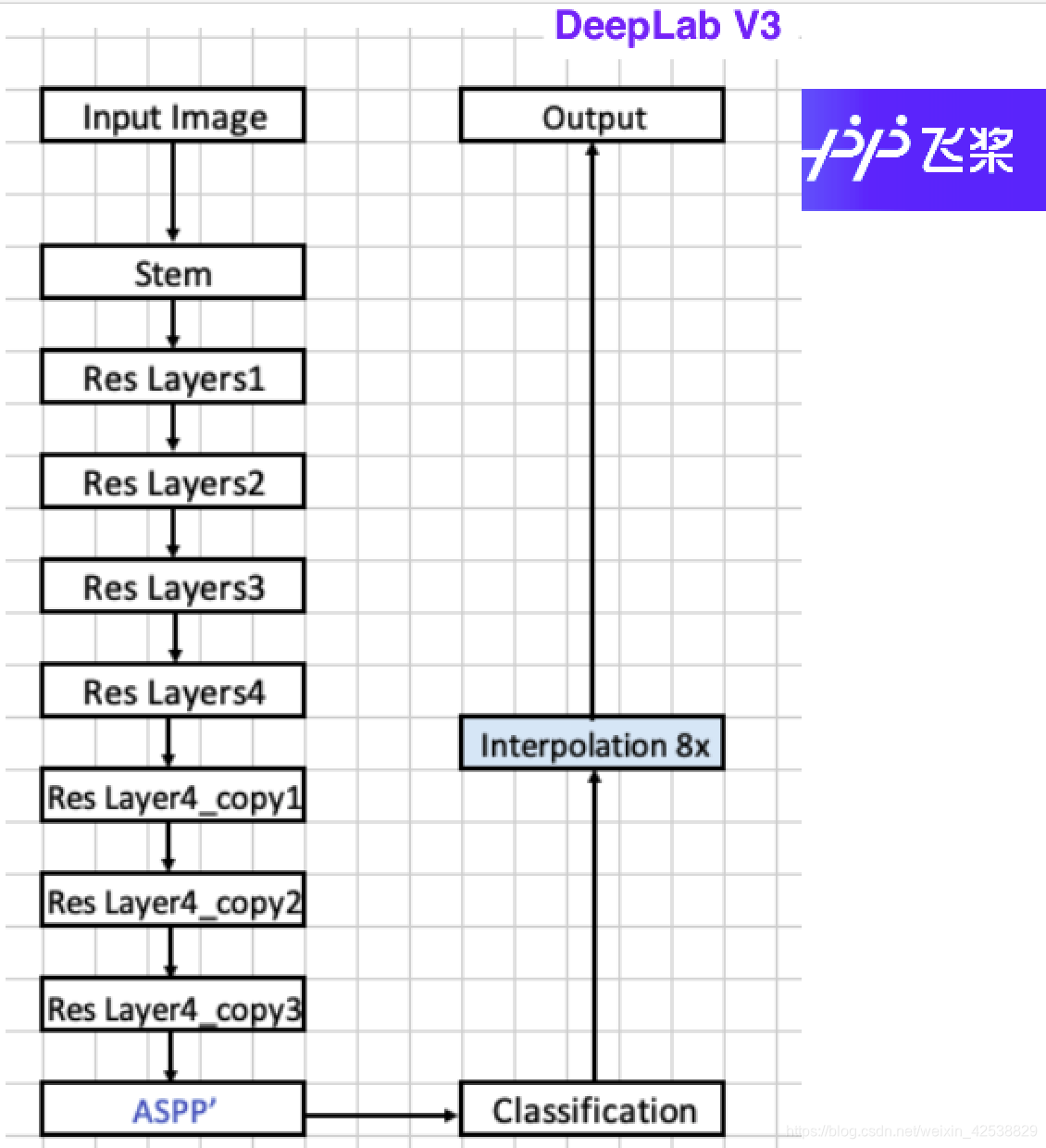
图中DeepLab V3使用的是ResNet的backbone,百度朱老师建议换成使用MobileNet作为骨干网络比较好。
三、实现代码
1.ASPPPooling
class ASPPPooling(Layer):
    def __init__(self, num_channels, num_filters):
        super(ASPPPooling, self).__init__()
        self.features = fluid.dygraph.Sequential(
                        Conv2D(num_channels, num_filters, 1),
                        BatchNorm(num_filters, act='relu')
                        )

    def forward(self, inputs):
        n, c, h, w = inputs.shape

        x = fluid.layers.adaptive_pool2d(inputs,1)
        x = self.features(x)

        x = fluid.layers.interpolate(x, (h, w), align_corners=False)
        return x
2.ASPPModule
class ASPPModule(Layer):
    def __init__(self, num_channels, num_filters, rates):
        super(ASPPModule, self).__init__()

        self.features = []
        self.features.append(
                fluid.dygraph.Sequential(
                    Conv2D(num_channels, num_filters, 1),
                    BatchNorm(num_filters, act='relu')
                )
        )
        self.features.append(ASPPPooling(num_channels, num_filters))

        for r in rates:
            self.features.append(
                ASPPConv(num_channels, num_filters, r)
                )
        self.project = fluid.dygraph.Sequential(
                                    Conv2D(num_filters*(2 + len(rates) ), num_filters, 1),
                                    BatchNorm(num_filters, act='relu'),
        )

    def forward(self, inputs):
        res = []
        for op in self.features:
            res.append(op(inputs))

        x = fluid.layers.concat(res,axis=1)
        x = self.project(x)

        return x
3.DeepLab
class DeepLab(Layer):
    def __init__(self, num_classes=59):
        super(DeepLab, self).__init__()

        back = ResNet50(pretrained=False, duplicate_blocks=True)

        self.layer0 = fluid.dygraph.Sequential(
                                    back.conv,
                                    back.pool2d_max,
                                    )
        self.layer1 = back.layer1
        self.layer2 = back.layer2
        self.layer3 = back.layer3

        # multigrid
        self.layer4 = back.layer4
        self.layer5 = back.layer5
        self.layer6 = back.layer6
        self.layer7 = back.layer7

        feature_dim = 2048
        self.classifier = DeepLabHead(feature_dim, num_classes)

    def forward(self, inputs):
        n, c, h, w = inputs.shape
        x = self.layer0(inputs)
        x = self.layer1(x)
        x = self.layer2(x)
        x = self.layer3(x)
        x = self.layer4(x)
        x = self.layer5(x)
        x = self.layer6(x)
        x = self.layer7(x)

        x = self.classifier(x)      # ASPP & classifier

        x = fluid.layers.interpolate(x, (h, w), align_corners=False)    # resize

        return  x
4.DeepLabHead
class DeepLabHead(fluid.dygraph.Sequential):
    def __init__(self, num_channels, num_classes):
        super(DeepLabHead, self).__init__(
                ASPPModule(num_channels, 256, [12, 24, 36]),
                Conv2D(256, 256, 3, padding=1),
                BatchNorm(256, act='relu'),
                Conv2D(256, num_classes, 1)
                )
5.ASPPConv
class ASPPConv(fluid.dygraph.Sequential):
    def __init__(self, num_channels, num_filters, dilation):
        super(ASPPConv, self).__init__(
            Conv2D(num_channels, num_filters, filter_size=3, padding=dilation, dilation=dilation),
            BatchNorm(num_filters, act='relu')
        )
6.main
def main():
    place = paddle.fluid.CUDAPlace(0)
    with fluid.dygraph.guard(place):
        x_data = np.random.rand(2, 3, 512, 512).astype(np.float32)
        x = to_variable(x_data)
        model = DeepLab(num_classes=59)
        model.eval()
        pred = model(x)
        print(pred.shape)

魔乐社区(Modelers.cn) 是一个中立、公益的人工智能社区,提供人工智能工具、模型、数据的托管、展示与应用协同服务,为人工智能开发及爱好者搭建开放的学习交流平台。社区通过理事会方式运作,由全产业链共同建设、共同运营、共同享有,推动国产AI生态繁荣发展。
更多推荐

 0
 0
- 0


 已为社区贡献1条内容

所有评论(0)